- Views: 854
- Replies: 1
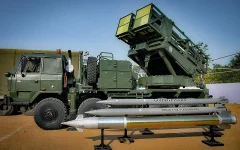
Noida-based private firm IG Defence has recently shed more light on its newest indigenous creation, the JWALA.
Showcased alongside other advanced platforms like the KAL drone at the North Tech Symposium 2026, JWALA emerges as a fast-reacting, short-range weapon that blurs the lines between a traditional missile and a loitering munition.
Marketed uniquely as a "one-way attack drone" capable of neutralising both aerial and ground targets, the system embodies a versatile design approach intended to offer operational flexibility rather than fitting neatly into a single conventional military category.
Under the hood, JWALA functions primarily as a short-range missile powered by a highly reliable solid-fuel, dual-pulse rocket motor.
This specific propulsion mechanism gives the weapon a powerful initial launch boost, followed by a secondary acceleration stage during its final approach.
Such an architecture preserves crucial energy for the weapon's endgame, drastically enhancing its ability to outmanoeuvre and intercept highly agile or fast-moving threats, including hostile unmanned aerial vehicles (UAVs) and cruise missiles.
With a projected engagement range spanning 10 to 100 kilometres and an operational altitude varying from just 50 metres up to 20,000 metres, JWALA directly addresses the critical space between Short-Range Air Defence (SHORAD) and Medium-Range Surface-to-Air Missile (MR-SAM) networks.
This particular combat airspace is heavily contested, requiring platforms to effectively counter threats as diverse as sea-skimming anti-ship weapons and medium-altitude fighter jets.
If these performance metrics hold true in field trials, JWALA will provide Indian forces with an adaptable asset suited for comprehensive air defence as well as precise tactical strikes.
To ensure pinpoint accuracy, the JWALA incorporates a sophisticated two-step guidance system.
During the middle of its flight, the weapon relies on an advanced inertial navigation system combined with command guidance from ground-based radars, which helps save the power of its internal sensors for the final attack phase.
Once it closes in on the objective, an onboard active Radio Frequency (RF) seeker—understood to be a modern Ku/X-band Active Electronically Scanned Array (AESA)—assumes control for independent tracking and a precision kill.
Compared to older mechanical radar systems, this AESA technology grants superior target identification, faster scanning, and a significantly higher resilience against enemy electronic jamming.
Packing a decisive punch, the system is armed with a 55 to 60-kilogram pre-fragmented high-explosive warhead equipped with both impact and proximity fuzes.
This setup indicates that JWALA is heavily tailored for destroying airborne threats while still packing enough destructive capability to eliminate ground installations.
While this dual-purpose utility perfectly matches IG Defence’s claims of surface-to-air and surface-to-surface proficiency, successfully maximising damage across such drastically different target profiles generally demands complex engineering compromises regarding how the weapon detonates and disperses shrapnel.
Built for immediate battlefield deployment, JWALA boasts an ultra-fast reaction time of less than 15 seconds from the moment a threat is spotted to the actual launch.
This rapid response is absolutely essential in modern combat scenarios where defenders have only seconds to react to stealthy, high-speed adversaries.
Furthermore, the platform does not operate in isolation; it is linked to a highly capable multi-function AESA radar that provides complete 360-degree coverage and a detection radius of 120 to 150 kilometres, functioning as a fully integrated node within a broader air defence grid.
The ultimate effectiveness of this modular, multi-platform system will heavily rely on its ability to communicate with unified military command structures, like the Indian Air Force’s Integrated Air Command and Control System (IACCS).
In contemporary warfare, an interceptor's success is entirely dependent on the broader sensor and communication network that guides it.
Should JWALA integrate flawlessly with India's established network architecture, it will serve as a vital, overlapping layer of national protection.
Despite its promising features, JWALA raises some practical and doctrinal questions.
Promoting the platform simultaneously as a "missile" and a "one-way attack drone" feels more like an industry marketing strategy than a concrete military classification.
Authentic loitering munitions are designed to hover over a battlefield and dynamically hunt for targets, whereas traditional missiles are engineered for outright speed and immediate interception.
Merging these two contrasting philosophies into a single weapon is an immense engineering hurdle, and the system's true hybrid nature will ultimately depend on whether it genuinely possesses the ability to loiter and re-assign targets mid-flight, or if it solely relies on standard missile flight profiles.