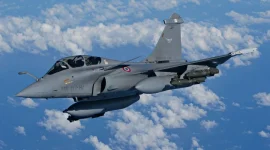
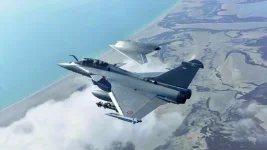
In a major leap for India’s defence modernisation, the government is actively seeking international partnerships to co-develop a sixth-generation fighter aircraft.
Speaking at the recent ANI National Security Summit 2.0, Defence Secretary Rajesh Kumar Singh stressed that the astronomical costs and complex technologies involved in next-generation fighters make global collaboration a necessity, rather than a choice.
Singh confirmed that New Delhi has formally reached out to the two major multinational groups currently working on advanced combat jets.
Noting that the immense scale of investment demands joint efforts, Singh explained that India has presented its interest to both ongoing three-country consortia.
The government has clearly communicated its willingness to collaborate as a partner in a sixth-generation fighter programme and is currently awaiting their responses.
The two ambitious projects in focus are the Global Combat Air Programme (GCAP), jointly led by the United Kingdom, Italy, and Japan, as well as the Future Combat Air System (FCAS), a collaborative effort between France, Germany, and Spain.
Both programmes are striving to build futuristic aircraft equipped with unparalleled stealth, artificial intelligence integration, directed energy weapons, and advanced sensor networking.
This outreach aligns with recent recommendations from a parliamentary committee, which advised the Indian Air Force to partner with a global consortium to avoid lagging behind in next-generation aerospace technology.
Creating a sixth-generation platform requires financial resources and research capabilities that are incredibly difficult for a single nation to manage independently.
By proposing to join these established international networks, India hopes to share the financial burdens, accelerate crucial technology transfers, and firmly embed its domestic aerospace industry into critical global supply chains.
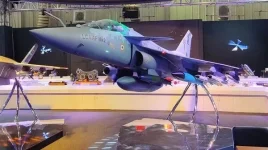
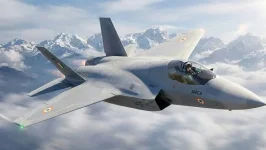
Simultaneously, India is aggressively advancing its own fifth-generation fighter jet project, the Advanced Medium Combat Aircraft (AMCA).
According to the Defence Secretary, a Request for Proposal (RFP) for the AMCA is expected to be issued soon to shortlisted private sector companies. This marks a strategic shift aimed at establishing multiple fighter production lines within the country.
By encouraging private sector participation, the government aims to reduce its reliance on a single public sector manufacturer, thereby securing a more robust and competitive defence supply chain.
In addition to manned aircraft, India is rapidly expanding its unmanned combat fleet to plug capability gaps.
Expanding on the Defence Secretary's updates, DRDO Chairman Dr. Samir V Kamat recently confirmed that the military plans to induct approximately 67 Ghatak Unmanned Combat Aerial Vehicles (UCAVs).
Dr. Kamat revealed that these sophisticated, autonomous drones will be in the 13-ton class, offering advanced strike capabilities comparable to modern stealth fighter jets.
These combined efforts illustrate a highly pragmatic approach by the Indian defence establishment.
Securing access to sixth-generation technology would be a transformative milestone amid shifting geopolitical dynamics in the Indo-Pacific.
By actively seeking co-development opportunities abroad while simultaneously pushing domestic fifth-generation and unmanned projects at home, India is positioning itself not merely as a buyer of military hardware, but as a future co-developer on the global stage.
Defence analysts are now closely observing how the partner nations respond to India's outreach.
Any positive momentum could launch a new era of international defence cooperation for New Delhi, successfully blending the pursuit of self-reliance with highly strategic global alliances.
With the AMCA moving toward the tender phase and formal talks for sixth-generation platforms initiated, India’s future air power capabilities are clearly on an aggressive upward trajectory.