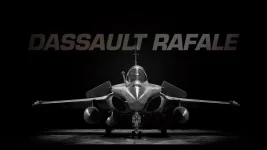
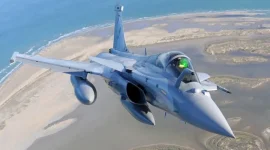
As New Delhi and Paris advance discussions on a sweeping, multi-billion-dollar acquisition of 114 Dassault Rafale multi-role fighter jets, critical roadblocks have emerged regarding technology transfer.
Sources close to the negotiations indicate that disputes over radar Intellectual Property Rights (IPR) and access to the aircraft’s core software are threatening to delay the agreement, a setback that comes at a time when the Indian Air Force (IAF) is urgently seeking to address its depleting fighter squadron strength.
Earlier this year, the IAF proposed a direct government-to-government agreement to the Ministry of Defence (MoD). This approach aims to bypass the lengthy Multi-Role Fighter Aircraft (MRFA) competitive tender.
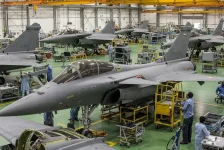
Valued at an estimated $36 billion, the proposed deal heavily emphasises the "Make in India" initiative, targeting over 60% indigenous content. To achieve this, manufacturing would largely take place locally at Dassault’s joint venture facility in Nagpur, Maharashtra.
Despite the strategic partnership between the two nations, defence insiders report that two major technical bottlenecks remain.
Firstly, Dassault Aviation insists that the IPR for the Rafale's cutting-edge RBE2 Active Electronically Scanned Array (AESA) radar belongs strictly to its French partner, Thales, making it difficult for India to modify or replace it.
Secondly, the fighter's highly classified source code—which acts as the digital "brain" controlling the mission computer, sensor fusion, and the SPECTRA electronic warfare suite—remains firmly locked behind French export restrictions. Paris views these codes as a vital national security asset safeguarding decades of proprietary technology.
For India, the lack of unrestricted access to this source code is a significant disadvantage. Without it, the IAF cannot independently arm the new Rafales with homegrown weapons, such as the Astra beyond-visual-range (BVR) missile or the Rudram next-generation anti-radiation missile.
This restriction would force India to rely on Dassault for all future upgrades, effectively trapping the IAF in a long-term, French-controlled maintenance and support cycle.
To bridge this divide, the MoD is pushing for access to the Interface Control Document (ICD). While the ICD is not the highly sensitive source code itself, it serves as a critical technical blueprint.
It dictates exactly how the aircraft’s hardware and software link up with external weapon systems, detailing electrical connections, data formats, and communication rules.
Gaining access to the ICD would empower India’s Defence Research and Development Organisation (DRDO) and its private sector partners to physically adapt the Rafale’s weapon-carrying infrastructure.
With this blueprint, Indian engineers could safely design their own heavy-duty pylons and adaptors to fit the specific weight and locking mechanisms of indigenous weapons like the advanced Astra Mk2, which boasts a range of over 160 kilometres.
Crucially, this can be done without compromising the jet’s aerodynamics or structural safety.
India has successfully used this exact strategy in the past. By securing deep interface data for the Russian Sukhoi Su-30MKI, Indian engineers were able to independently upgrade the fighter’s heavy-duty underbelly electronics and hardware.
This allowed the IAF to successfully mount the massive, supersonic BrahMos cruise missile onto the Su-30MKI without requiring constant Russian oversight.
However, the demand for ICD control has caused friction in Indo-French defence negotiations.
India views this access as non-negotiable for its technological sovereignty, operational autonomy, and the broader goals of Aatmanirbhar Bharat. The MoD is determined not to repeat past mistakes, such as the costly and delayed upgrades to the Mirage 2000 fleet, which were severely hampered by restricted software access.
On the other side of the table, France and its defence consortium (including Dassault, Thales, Safran, and MBDA) hesitate to hand over interface technologies, fearing that providing such deep access could expose their complex algorithms to reverse-engineering.
Securing software autonomy for the Rafale fleet holds strategic importance that extends far beyond a single aircraft.
The architecture of India's indigenous Uttam AESA radar—which is currently being integrated into the Tejas Mk1A and features over 900 transmit/receive modules—forms the backbone for future Indian aviation projects. This includes the Tejas Mk2, the Advanced Medium Combat Aircraft (AMCA), and the upcoming Super Sukhoi upgrades.
Although these radars will vary in size and processing power, they will share a common software foundation. Having full control over the digital infrastructure ensures that new indigenous weapons can be integrated smoothly across all platforms without foreign permission, ultimately creating a unified and networked fighting force to protect India's borders.