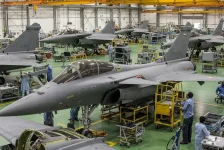
India has established firm, non-negotiable requirements for the prospective purchase of 114 Dassault Rafale fighter jets under the Multi-Role Fighter Aircraft (MRFA) program.
The government has mandated that the acquisition be strictly rooted in the “Make in India” initiative, demanding deep Transfer of Technology (ToT) and a high percentage of localized manufacturing through a strategic partnership between the French aerospace giant and an Indian firm.
Under the blueprint for this mega-deal, Dassault Aviation must share critical manufacturing technologies with India.
This comprehensive transfer goes beyond basic assembly, encompassing the aircraft's physical structure (airframe), the engines developed by Safran, and the advanced avionics and mission systems supplied by Thales.
A primary stipulation from the Indian side is the full integration of domestically produced missiles, smart munitions, and general ammunition across the entire fleet of 114 jets.
By ensuring the aircraft can fire Indian-made armaments—such as the Astra beyond-visual-range (BVR) air-to-air missile and the Smart Anti-Airfield Weapon (SAAW)—the Indian Air Force (IAF) aims to eliminate its reliance on foreign weapon suppliers.
This move is designed to maximize operational independence and advance the nation’s broader push for self-reliance in the defence sector.
Additionally, New Delhi requires the integration of custom, highly secure data links.
These communication upgrades will allow the new fighters to plug directly into India’s indigenous Integrated Air Command and Communication System (IACCS).
This secure digital bridge will enable the jets to seamlessly share real-time targeting telemetry and battlefield imagery with ground stations and other Indian platforms, greatly enhancing network-centric combat operations.
The IAF already operates a fleet of 36 Rafale jets acquired through a 2016 inter-governmental agreement, which are built to the F3R standard.
For the upcoming 114-jet order, Dassault has moved forward to the F4 standard, and India is reportedly aiming for a hybrid configuration that blends the F4 variant with capabilities slated for the futuristic F5 standard.
These newer variants are slated to be equipped with a cutting-edge Active Electronically Scanned Array (AESA) radar—an evolution of the Thales RBE2—that delivers superior tracking ranges and robust resistance to enemy jamming.
Furthermore, the aircraft will be protected by an upgraded electronic warfare suite, likely an evolution of the highly regarded SPECTRA system, designed to detect, intercept, and neutralize modern surface-to-air and air-to-air threats.
Looking ahead, the integration of F5 standard technologies will introduce high-bandwidth satellite communications and advanced artificial intelligence (AI).
These AI systems will act as virtual co-pilots, processing complex battlefield data to speed up human decision-making during high-stakes combat missions, and potentially controlling loyal wingman drones in the future.
The ultimate goal of this sweeping ToT agreement is to achieve an indigenous content rate of 55% to 60% once domestic manufacturing of the airframe, engine, and avionics is fully active.
If successful, this would be one of the most extensive technology transfers in the history of Indian military aviation, laying a massive foundation for the country's private and public aerospace sectors.
This massive procurement is a critical piece of the IAF's strategy to arrest the depletion of its fighter squadrons.
It also offers unprecedented joint-service synergy. With the Indian Navy already in the process of acquiring 26 Rafale-Marine (Rafale M) fighters for its aircraft carriers, adding 114 more to the Air Force would create a massive shared pool for logistics, spare parts, and training, drastically driving down the lifecycle costs of the aircraft for both services.
Logistically, the IAF is already prepared for expansion. India has established a comprehensive Rafale Maintenance, Repair, and Overhaul (MRO) and flight training facility at the Ambala Air Force Station.
With this existing infrastructure, alongside the second Rafale base at Hasimara, the IAF currently possesses the technical tooling, physical space, and trained personnel required to seamlessly absorb at least two additional squadrons (36 to 38 aircraft) the moment deliveries begin.