- Views: 5K
- Replies: 13
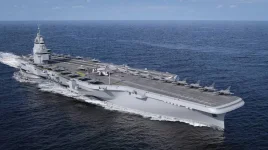
The blueprint for India’s next-generation aircraft carrier is steadily taking shape as the Indian Navy and the Defence Research and Development Organisation (DRDO) refine the concept for the Indigenous Aircraft Carrier-III (IAC-III), widely known as INS Vishal.
While the Navy anticipates formal government approval for a second INS Vikrant-class carrier to sustain its immediate fleet requirements, simultaneous technological breakthroughs are driving a highly ambitious and modern design philosophy for the country’s future flagship.
Key milestones recently achieved by DRDO and the Aeronautical Development Agency (ADA) using scaled technology demonstrators are actively influencing the architectural framework of the IAC-III.
Within India's naval aviation sector, these testbeds are recognised as essential building blocks for future carrier operations.
The primary focus of these innovations rests on integrating unmanned combat aviation and mastering manned-unmanned teaming (MUM-T) capabilities.
The envisioned design for INS Vishal marks a substantial evolution from the current 45,000-tonne INS Vikrant.
The IAC-III is projected to be a massive 65,000 to 70,000-tonne flat-top vessel capable of operating a highly advanced, diverse air wing of over 50 aircraft.
Although the Navy has always favoured a larger supercarrier platform, budgetary realities initially prompted a strategic compromise, leading to the short-term pursuit of a repeat Vikrant-class ship to rapidly expand fleet numbers.
However, the long-term vision for a heavy-deck carrier remains fully active.
By early 2026, the Indian Navy successfully advanced a proposal for the acquisition of a sister ship to INS Vikrant (referred to as IAC-II).
This pragmatic approach ensures that India will maintain a formidable three-carrier fleet presence in the near future, providing a secure operational buffer while the technologically intricate design phase of the IAC-III progresses towards a projected commissioning in the 2030s.
Defence sources indicate that the conceptual framework for INS Vishal represents a paradigm shift in carrier aviation, heavily centred on Manned-Unmanned Teaming (MUM-T).
The IAC-III is slated to be India's first naval platform explicitly designed from its inception to seamlessly integrate unmanned combat systems alongside traditional fighter jets, such as the newly procured Rafale M or the upcoming Twin Engine Deck Based Fighter (TEDBF).
This strategic pivot is directly inspired by rapid progress in DRDO’s stealth drone programmes.
Crucial validation for this futuristic air wing came from the successful trials of the Stealth Wing Flying Testbed (SWiFT).
This demonstrator effectively proved the viability of a stealthy flying-wing design, autonomous flight controls, and internal weapons carriage capabilities.
These tested technologies are the foundation of India's ambitious Ghatak Unmanned Combat Aerial Vehicle (UCAV) programme and are directly shaping the Navy’s requirements for carrier-capable stealth drones.
According to current operational concepts, the IAC-III will host a dedicated squadron of stealth UCAVs flying in tandem with manned combat aircraft.
This hybrid configuration will exponentially multiply the carrier strike group's capabilities in surveillance, electronic warfare, and precision strikes, all while keeping human pilots out of highly contested, high-threat airspace.
A navalised version of the 13-tonne Ghatak UCAV is anticipated to be a cornerstone of this next-generation air wing.
Recent reports from early 2026 even suggest the Defence Procurement Board (DPB) has already recommended the acquisition of a large batch of Ghatak drones, underlining the maturity of the system.
Beyond stealth strike platforms, INS Vishal is being tailored to launch and recover a broad spectrum of unmanned systems.
This includes Medium Altitude Long Endurance (MALE) drones, short-range rotorcraft, and collaborative combat drones.
These assets will function under the Naval Collaborative Combat Air Vehicles (N-CCAV) framework.
Drawing inspiration from indigenous "loyal wingman" initiatives like the Abhimanyu programme by the National Aerospace Laboratories, these semi-autonomous drones will fly alongside manned fighters to execute reconnaissance, deploy electronic countermeasures, act as decoys, and conduct precision strikes.
The carrier's diverse aviation complement is also expected to feature jet-powered High Altitude Long Endurance (HALE) UAVs.
Designed for extended maritime domain awareness, these high-flying platforms will push the carrier strike group’s sensor net and surveillance reach far beyond the limits of conventional airborne early warning helicopters, providing unparalleled oversight of the Indian Ocean Region.
The rapid maturation of these technologies has greatly accelerated DRDO’s specific efforts towards a Deck-Based UCAV.
Constructed utilising advanced carbon prepreg composites for maximum stealth and payload capacity, this navalised drone is being engineered for deep penetration strikes and long-range intelligence gathering.
The ability to strike high-value targets in heavily defended environments without risking a pilot represents a massive leap in India's power projection capabilities.
Looking beyond its revolutionary air wing, the IAC-III will be a marvel of modern naval engineering.
The 65,000-tonne vessel is slated to ditch traditional launch systems in favour of a Catapult Assisted Take-Off But Arrested Recovery (CATOBAR) configuration, potentially utilising an Electromagnetic Aircraft Launch System (EMALS).
To power this, the carrier is expected to feature either nuclear propulsion or an integrated full-electric propulsion (IFEP) system.
These advanced powerplants offer the massive energy generation required for electromagnetic catapults, high-power radar sensors, and future directed-energy weapons.
Furthermore, INS Vishal will integrate extensive automation across ship operations, damage control, and routine maintenance.
This will not only optimise the ship's overall operational efficiency but also significantly reduce the required crew complement compared to older vessels, making the IAC-III a generational leap in Indian naval architecture.
Currently, the Indian Navy projects power across the seas using two aircraft carriers: the Russian-origin INS Vikramaditya and the indigenously constructed INS Vikrant, which entered service in 2022.
Securing a second Vikrant-class carrier in the immediate future will guarantee that India maintains uninterrupted carrier availability to secure its maritime interests, laying a solid foundation for the eventual arrival of the mighty INS Vishal.