- Views: 1K
- Replies: 6
India’s advanced rocket artillery capabilities are increasingly capturing the interest of European militaries as they look for economical solutions to replenish their diminishing armouries.
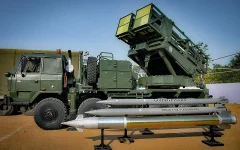
The Guided Pinaka Mk3, a cutting-edge evolution of India’s domestic rocket family, is currently being presented to several European capitals. These nations are actively seeking budget-friendly alternatives to high-priced Western artillery platforms.
This diplomatic and commercial push follows India's recent milestone in early 2026, when Defence Minister Rajnath Singh flagged off the first export shipment of the Guided Pinaka system to Armenia, cementing the system's credibility on the global market.
The heavy volume of military aid supplied to Ukraine over the course of the ongoing conflict has left European artillery reserves critically low.
Consequently, defence forces across the continent are in urgent need of long-range rocket systems that are both highly effective and ready for immediate deployment.
Although local European manufacturing efforts are underway—most notably France’s FLP-T (Feux Longue Portée-Terre) programme, which aims to replace its ageing LRU launchers with a sovereign system—these domestic solutions are still in the prototype phase and will not be fully operational for several years.
Until these local programmes are battle-ready, European armies need proven, intermediate systems to fill the gap.
In the European defence arena, the Pinaka platform is now competing directly with prominent rocket systems such as the American M142 HIMARS and the Israeli PULS.
Current reports highlight that at least three to four European nations are negotiating with New Delhi regarding the potential acquisition of the guided Pinaka.
This surge in interest gained momentum after the system was showcased to France. Indian officials have heavily emphasised the system’s unique ability to deliver massive area saturation combined with highly precise strikes.
The system's raw firepower has already garnered international praise. During recent visits to India, French Army Brigadier General Stéphane Richou openly commended the Pinaka’s exceptional rapid-fire capabilities.
A single Pinaka battery can unleash a complete salvo of 12 rockets in a mere 44 seconds, effectively neutralising an area of approximately one square kilometre.
This devastating saturation makes it an ideal weapon for dismantling enemy troop formations, logistics centres, and hostile artillery batteries in a matter of moments.
France is paying particularly close attention to the newest iteration: the Pinaka Mk3 Long Range Guided Rocket (LRGR). This modernised variant drastically pushes the operational envelope, boasting an extended strike range of 120 to 130 kilometres.
Furthermore, it incorporates advanced navigation to ensure pinpoint accuracy, registering a Circular Error Probable (CEP) of under 10 metres.
To ensure the Pinaka is fully interoperable with NATO standards, India’s Defence Research and Development Organisation (DRDO) is actively modifying the system's digital framework to seamlessly link with French and European command-and-control networks.
This ongoing adaptation, coupled with the rising interest from NATO members, highlights India's rapid transition from a traditional arms importer to a formidable exporter in the highly competitive global defence market.