Recent visual leaks of a new aircraft concept have captured the attention of maritime aviation experts, indicating that the Indian Navy might be considering two separate designs for carrier-based Collaborative Combat Aircraft (CCA).
Should these visual models align with official strategy, it would signal a profound evolution in naval doctrine, permanently embedding unmanned combat systems into the heart of India's carrier strike groups.
This reflects a broader push to modernize India's maritime defence posture, ensuring future readiness alongside crewed platforms like the Rafale-M and the upcoming Twin-Engine Deck-Based Fighter (TEDBF).
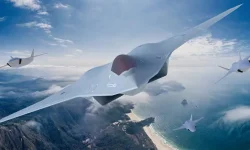
The leaked concept illustrates two substantial unmanned aerial vehicles (UAVs) stationed on a flight deck.
Both drones appear notably larger than the LCA Navy, which is roughly 13.2 metres long. While the first variant shares dimensions similar to—or marginally exceeding—the LCA Navy, the second is significantly more massive.
Crucially, the larger model features folding wings, an essential design element that allows aircraft to fit into the confined hangar spaces and elevators of modern warships like the INS Vikrant.
Two Distinct CCA Classes for the Future Fleet
The depiction of dual platform sizes strongly suggests the Indian Navy is adopting a multi-tiered strategy for its unmanned naval aviation.The smaller aircraft functions as a medium-weight Unmanned Combat Aerial Vehicle (UCAV), likely designed to serve as a "loyal wingman" for reconnaissance, electronic warfare, and escorting manned fighters.
Open-source estimates note that this medium drone would physically surpass the 9.1-metre CATS Warrior currently under development, complementing other parallel projects like the lighter 'Abhimanyu' N-CCAV being developed under the iDEX initiative.
Meanwhile, the heavier platform with foldable wings is speculated to be in the 20-ton weight class, drawing comparisons to advanced global counterparts like the US Navy's MQ-25 Stingray, albeit with an added focus on heavy strike capabilities.
The inclusion of a wing-folding mechanism proves that this drone is not a mere experimental concept, but a highly practical design engineered for long-term operational deployment on aircraft carriers, maximising deck efficiency.
Power and Reliability Through Twin Engines
A key takeaway from the concept image is the twin-engine layout visible on both drones.Utilizing two engines is a strategic decision for carrier-borne UCAVs, as it provides greater thrust and allows for heavier payloads.
More importantly, it ensures critical redundancy. In the unforgiving environment of oceanic flight, where engine failure during launch or recovery can be catastrophic, a twin-engine setup drastically improves safety margins.
Defence analysts suggest these aircraft could be powered by indigenous engines, such as dual Hindustan Turbo Fan Engine-25 (HTFE-25) motors or modified Kaveri derivatives.
A pairing of two HTFE-25 engines would generate approximately 50 kilonewtons (kN) of thrust, providing ample power for subsonic combat missions carrying heavy munitions.
Alternatively, an upgraded Kaveri engine could supply even greater thrust, potentially unlocking supercruise capabilities or allowing for massive payload capacities.
Transforming India's Naval Strike Capabilities
The pursuit of deck-based CCAs is perfectly aligned with the global military shift toward blending unmanned systems with traditional carrier wings.By flying alongside human-piloted fighters, these drones extend the operational range and improve the survivability of the entire fleet.
For the Indian Navy, deploying such UCAVs would mean transferring dangerous tasks—such as penetrating deep enemy air defences, conducting electronic jamming, or gathering high-risk intelligence—away from human pilots.
This integration acts as a massive force multiplier, radically boosting the striking power of Indian aircraft carriers.
Furthermore, the existence of the massive 20-ton class UCAV points to ambitions that go far beyond the standard "loyal wingman" support role.
Aircraft of this magnitude are built to linger in the air for many hours, carry substantial weapon loads, and house sophisticated sensor networks.
This implies the Indian Navy is actively preparing for an era where autonomous carrier drones can execute independent, deep-penetrating attacks against enemy warships and coastal targets, while linking seamlessly with network-centric warfare grids.
Ultimately, if these preliminary concepts mature into active defence programmes, it will revolutionise India's maritime strategy.
Successfully fielding large, twin-engine UCAVs from carrier decks would firmly establish the Indian Navy as one of the few global powers mastering the next generation of unmanned naval warfare.