- Views: 2K
- Replies: 1
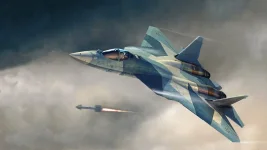
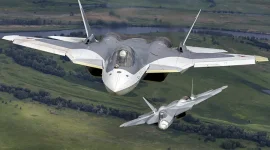
Russia's newly revealed two-seat Su-57 stealth fighter is increasingly being viewed as the direct successor to a shelved Indo-Russian joint venture.
Recent statements from within the Russian aviation industry openly admit that the aircraft's core design was fundamentally shaped by India's specific requirements.
According to a widely shared Russian report regarding the jet's development, the new twin-seat model was swiftly adapted from an older test aircraft, known as the "055" prototype.
The report bluntly noted that the modification was done because "the Indians wanted such an aircraft, and we customized it for them."
This highlights a key historical point, as India had strongly advocated for a two-seat fifth-generation fighter during the initial Fifth Generation Fighter Aircraft (FGFA) negotiations before ultimately walking away from the partnership in 2018.
The aircraft currently undergoing flight trials is understood to be a heavily modified T-50-5 prototype.
This specific airframe notably suffered a severe engine fire in 2014 during tests at the Zhukovsky airfield—an incident that occurred in full view of visiting Indian delegates.
Rather than constructing a completely new jet, Russian engineers rebuilt the aircraft's front section to house a tandem cockpit, drawing direct inspiration from the Su-30MKI fighters currently serving as the backbone of the Indian Air Force.
Open-source flight tracking and official releases confirm this aircraft still carries the bort number "055 Blue" and successfully completed its maiden flight in this new configuration on May 19, 2026, flown by renowned Sukhoi test pilot Sergei Bogdan.
The arrival of this modified fighter confirms long-held suspicions that Moscow continued to develop the FGFA concepts even after New Delhi exited the project.
India had originally withdrawn due to concerns over stealth capabilities, engine readiness, total costs, and the level of technology transfer.
Today, the new two-seat Su-57—sometimes referred to by Russian aviation bloggers as the Su-57D or Su-57UB—looks remarkably like the aircraft Indian defence experts envisioned the FGFA would eventually become if the collaboration had survived.
Russia's state-owned defence conglomerate, Rostec, alongside First Deputy Prime Minister Denis Manturov, has clarified that this jet is built for much more than simply training new pilots.
Official statements outline that the aircraft is designed to act as an advanced airborne command centre.
The second crew member in the rear seat will serve as a tactical battle manager, directing a mixed fleet of crewed jets and uncrewed combat drones in a highly networked combat environment.
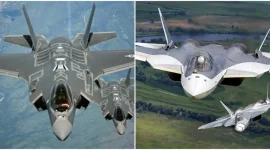
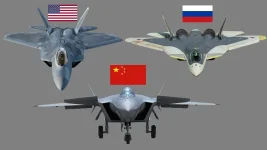
This approach directly mirrors the strategy behind China's J-20S, another twin-seat stealth fighter designed specifically for manned-unmanned teaming operations.
Visual evidence from the prototype reinforces this futuristic combat role.
The aircraft sports a new tail logo that features the silhouettes of both the Su-57 and the S-70 Okhotnik stealth drone.
Russian military planners have consistently marketed the heavy 20-ton Okhotnik as a "loyal wingman" designed to fly into heavily defended airspace under the direct control of a lead fighter.
This development comes at a critical time, as Russia has spent early 2026 aggressively pitching the Su-57 to India.
With India's own Advanced Medium Combat Aircraft (AMCA) program not expected to field operational jets until the mid-2030s, Moscow is presenting the Su-57 as an ideal stopgap fifth-generation solution.
During the Wings India 2026 exhibition in Hyderabad, Russian representatives offered generous technology transfer agreements.
They also proposed integrating indigenous Indian weapons, such as the BrahMos cruise missile and the Astra beyond-visual-range air-to-air missile, directly into the Su-57.
The sudden physical availability of a two-seat model makes this offer even more appealing, as the Indian military has long preferred dual-seat fighters for complex strike missions, sensor management, and future drone coordination.
Despite the tactical advantages of an airborne command post, the modification is not without its drawbacks. Adding a second cockpit requires significant engineering compromises.
Russian aviation analysts concede that the structural changes will likely reduce the fighter's internal fuel storage, negatively impact its aerodynamic performance, and potentially compromise its frontal stealth characteristics.
As regional rivals advance their own stealth capabilities, India will have to carefully weigh these trade-offs if it considers reviving its interest in the Russian platform.