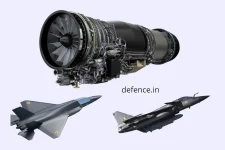
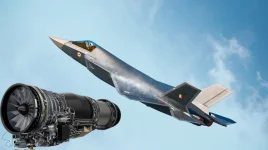
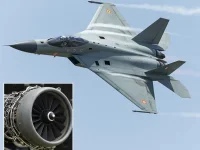
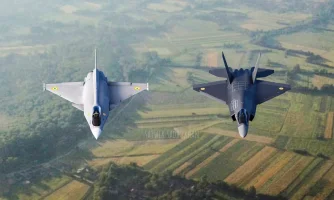
The development of India’s Advanced Medium Combat Aircraft (AMCA) is taking a unique path in the realm of fifth-generation fighters.
Instead of solely chasing low radar signatures, planners are placing an equal emphasis on keeping the jet easy to maintain—a philosophy rarely seen in public discussions regarding modern combat aviation.
Historically, stealth jets are judged by their supercruise speeds, advanced sensors, and radar evasion capabilities.
However, Western projects have shown that keeping these low-observable aircraft combat-ready in real-world scenarios is a massive, and often crippling, logistical challenge.
The American F-35, for instance, has struggled with poor mission readiness due to delicate radar-absorbent coatings, complex software bugs, and supply chain bottlenecks.
For the Indian Air Force (IAF), which is dealing with depleting squadron numbers and the looming threat of a two-front war, low availability rates are simply not an option.
Consequently, the Aeronautical Development Agency (ADA) and the Defence Research and Development Organisation (DRDO) are building the AMCA with a totally different mindset.
Backed by a ₹15,000 crore budget approved by the Cabinet Committee on Security in 2024, their goal is maximum uptime through smart, digital fleet management, aiming for a gold-standard 75% mission-capable fleet availability rate.
The Power of AI and Predictive Maintenance
This new strategy is anchored by an Integrated Vehicle Health Management (IVHM) system, intended to drastically cut down the time it takes to service the jet between missions.A major part of this involves new Flight Data Management Systems (FDMS) that utilise "Digital Twin" technology.
Rather than servicing the aircraft on a rigid calendar schedule, the AMCA will use artificial intelligence to analyse massive amounts of flight data and predict when parts will fail.
During a flight, internal sensors will constantly track tiny vibrations, temperature changes, and power fluctuations. AI tools will spot the earliest signs of wear long before a part actually breaks.
If a component shows unusual behaviour—such as a hydraulic pump vibrating irregularly—the system will immediately notify ground crews. Technicians can have a replacement part ready on the tarmac before the jet even touches down, speeding up turnaround times.
This marks a massive departure from traditional aviation maintenance, where crews wait for a set number of flying hours or a visible breakdown before taking action.
"Baked-In" Stealth and Structural Monitoring
Furthermore, India is rethinking how to manage stealth materials.The F-35 requires tedious, manpower-heavy reapplication of delicate external stealth coatings whenever maintenance panels are opened.
In contrast, DRDO is integrating radar-absorbing properties directly into the AMCA’s carbon-fibre composite structure.
This "baked-in" stealth approach is far more durable and requires less upkeep in the field.
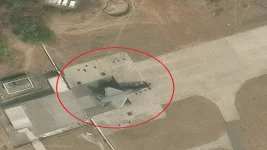
Recent satellite imagery of an AMCA engineering model undergoing full-scale validation at the ORANGE radar cross-section facility in Dundigal suggests that these structural stealth concepts have already matured significantly ahead of the prototype's expected rollout in 2028-2029.
The ADA is also acquiring embedded fibre optic sensors for the aircraft's frame. These sensors will constantly measure structural stress and material fatigue from the inside out.
This eliminates the need for crews to manually scan the jet's skin with external ultrasonic equipment, ensuring the external shape—crucial for evading radar—remains flawless throughout its service life.
Modular Repairs for Rapid Turnaround
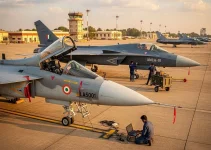
Quick fault isolation is another central feature of the aircraft's design. The AMCA will use modular Line Replaceable Units (LRUs) for its open-architecture electronics.If a computer or sensor fails, the jet's health system will pinpoint the exact module. Ground crews can quickly swap the broken unit on the flightline, rather than grounding the whole plane for complex wiring checks, allowing the defective part to be repaired separately.
Ultimately, India is choosing a balanced approach for its fifth-generation fighter ahead of its targeted operational induction in the mid-2030s. Rather than chasing absolute stealth at the expense of practicality, the AMCA is designed for sustained wartime endurance.
A fighter jet that can fly multiple missions a day with minimal downtime will provide the IAF with far more genuine combat power than a highly stealthy but frequently grounded alternative.