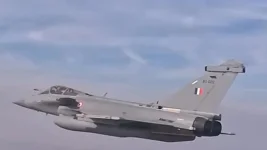
As the Indian Air Force advances toward acquiring a massive fleet of 114 Rafale fighters, military planners in Islamabad are shifting their long-term strategy.
Rather than attempting to match New Delhi jet-for-jet, the Pakistan Air Force (PAF) is turning to Beijing to build a highly integrated, technology-driven combat network.
Following the intense military exchanges during India’s Operation Sindoor in May 2025, defence experts note a stark change in Pakistan's approach.
To prepare for the overwhelming capabilities of India's future Rafale squadrons, Islamabad is assembling a "Chinese-backed kill-chain."
This strategy pivots away from merely buying more planes and instead focuses on a cohesive ecosystem that seamlessly links stealth aircraft, long-range missiles, surveillance planes, drones, and robust command centres.
At the heart of this modernization is the anticipated purchase of up to 40 Chinese-made J-35A fifth-generation stealth fighters. Reports indicate that Pakistani pilots may have already commenced training on these advanced jets in China.
Unlike older generations of fighters that rely on electronic jamming and distance for survival, the J-35 utilizes a low-observable design to evade radar.
By deploying these stealth jets, the PAF hopes to disrupt the advanced sensors of the Rafale, effectively neutralizing the French-made fighter's crucial "first-look, first-shot" superiority.
However, the stealth jets are just one piece of the puzzle; the true threat lies in the broader "system-of-systems" network.
To manage this battlespace, Pakistan is seeking to acquire Chinese KJ-500 Airborne Early Warning and Control (AEW&C) aircraft.
These "flying radars" act as airborne command hubs, extending surveillance deep into contested airspace and coordinating strikes for other fighters like the J-10C and JF-17 Block III.
This high-level networking is designed to share target data instantly across the fleet, allowing multiple platforms to engage simultaneously and offset India's numerical dominance.
Arming this networked fleet is the PL-15E beyond-visual-range (BVR) air-to-air missile, which has become standard across Pakistan's modern squadrons. There are also indications that the even longer-range PL-17 could eventually be introduced.
By outfitting numerous jets with these advanced missiles, Pakistan intends to present a multi-directional threat.
The strategy is not necessarily to guarantee hits at extreme distances, but rather to force Indian formations into defensive manoeuvres, breaking their ranks before close combat can even begin.
The financial strain of matching India's 114-jet procurement scale is simply too great for Pakistan's current economy. As a result, Islamabad is leaning heavily on cost-effective, asymmetric tactics to level the playing field.
A major component of this budget-conscious strategy is the heavy reliance on unmanned combat aerial vehicles (UCAVs), such as the Turkish Akıncı and the Chinese Wing Loong II.
In future conflicts, these relatively cheap combat drones are expected to be deployed in swarms to saturate and exhaust Indian air defence systems, clearing a safer path for manned fighters to operate.
Furthermore, reports suggest Pakistan is incorporating Chinese HQ-19 high-altitude missile defence systems to further protect its own airspace and integrated network.
Simultaneously, the PAF is not abandoning its existing fleet. Heavy investments are being poured into the JF-17 Block III programme to upgrade radars, electronic warfare capabilities, and weapons systems.
This ensures that a large quantity of affordable jets remains potent in a modern fight. By networking upgraded older jets with cutting-edge stealth fighters and drones, Pakistan aims to create a combined force that punches well above its weight.
Finally, the stark lessons learned from India’s precise strikes during Operation Sindoor have driven Pakistan to drastically improve its ground resilience.
The PAF is rapidly reinforcing hardened aircraft shelters, establishing mobile command units, and preparing alternative runways to ensure its air power survives the critical early hours of any future conflict.