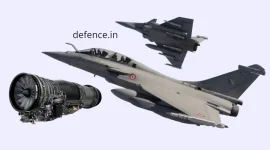
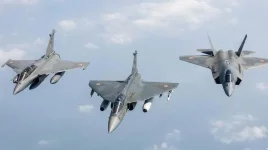
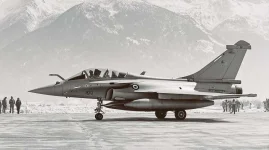
A newly released Request for Proposal (RFP) from the Indian Air Force regarding logistics support for its Rafale combat fleet has effectively crushed ongoing internet narratives from Pakistani commentators, who have persistently claimed that several Indian Rafale jets were shot down during the May 2025 Operation Sindoor conflict.
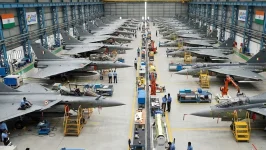
The June 2026 tender, which has recently gained widespread attention online, outlines the requirements for continued maintenance and performance-based logistics for the Indian Air Force's complete fleet of 36 Rafale fighter jets.
While acquiring short-term maintenance contracts is standard procedure for advanced military hardware, the specific requirement covering all 36 initial aircraft directly shatters Pakistan's fabricated reports of destroying Indian jets.
According to the tender, the Indian Air Force is referring to the original batch of 36 fighters procured from France's Dassault Aviation under a September 2016 Inter-Governmental Agreement.
The initial contract included comprehensive consumable spares and long-term Performance-Based Logistics (PBL) support.
With that original support package set to expire in September 2026, the IAF is actively seeking a five-month "bridge support" contract—covering an estimated 150 flying hours per aircraft annually—to guarantee seamless operational readiness until a permanent, long-term maintenance deal is finalised.
The controversy dates back to the aftermath of Operation Sindoor, a multi-domain military campaign launched by India in response to the April 2025 Pahalgam terror attack.
During the ensuing aerial skirmishes, Pakistan’s military spokespersons falsely claimed to have neutralised four Indian Rafale fighters.
To bolster their propaganda, they even publicised specific tail numbers—RB001, RB021, RB022, and RB027—making these false assertions a core piece of their domestic media and internet campaigns.
However, independent defence and aviation analysts quickly dismantled these claims, pointing out the complete lack of verifiable wreckage or evidence.
The final blow to this misinformation campaign came when the exact aircraft Pakistan listed as "destroyed" were visibly recorded participating in subsequent IAF missions, operational deployments, and public fly-pasts, exposing the complete inaccuracy of the initial reports.
The newly published RFP provides the ultimate official confirmation. By legally mandating bridge support for the upkeep of all 36 acquired jets, the Indian government proves that the entire fleet remains fully intact and active.
While critics of military transparency often note that logistics paperwork alone shouldn't be read out of context, in this case, the explicit inclusion of the entire fleet size leaves no room for debate regarding wartime aircraft losses.
Ultimately, the document serves as a routine but vital maintenance request rather than a dedicated press release about the 2025 conflict.
Securing interim logistics is a standard global practice to keep highly advanced, manufacturer-supported military platforms flying without interruption during contract transitions.
This situation perfectly illustrates how routine defence procurement files frequently become key weapons in the modern information war.
Following major military operations, public tenders and logistical contracts are intensely analysed by open-source intelligence communities to either validate or debunk state-sponsored narratives.
For the Indian Air Force, the primary goal of this RFP is simply to sustain the peak combat readiness of its premier strike fighters.
Meanwhile, India continues to expand its aerial dominance, with advanced discussions currently underway to procure an additional 114 Rafale jets under the Multi-Role Fighter Aircraft (MRFA) programme, alongside 26 Rafale-M variants for the Indian Navy.
For the global public and defence watchers, however, the routine maintenance tender has successfully closed the book on Pakistan's Operation Sindoor aerial propaganda.