- Views: 2K
- Replies: 11
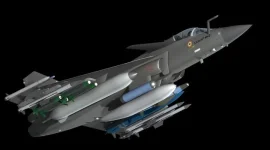
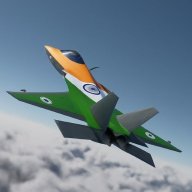
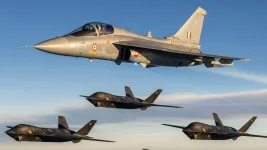
As India gears up for the anticipated maiden flight of the LCA Tejas Mk2 in mid-2026, the Medium Weight Fighter (MWF) is showcasing a major shift in how the nation approaches combat aircraft design.
While it is not a full fifth-generation stealth jet like the upcoming Advanced Medium Combat Aircraft (AMCA), the Aeronautical Development Agency (ADA) is equipping the Mk2 with advanced radar cross-section (RCS) reduction technologies.
This strategic focus aims to make the Mk2 one of the most difficult 4.5-generation fighters to detect on enemy radar screens.
The Power of Advanced Composites
A key element of this low-observability strategy is the heavy reliance on composite materials, which make up a vast majority of the aircraft's surface.The previous Tejas Mk1 and Mk1A models already utilised composites, but the Mk2 takes this a step further by using advanced manufacturing methods learned from the AMCA project.
Materials like Carbon Fibre Reinforced Plastic (CFRP) naturally bounce back less radar energy than traditional metals.
More importantly, precise building techniques help reduce gaps, hide fasteners, and smooth out uneven surfaces that usually catch radar waves.
This creates a highly unified exterior that scatters radar signals effectively.
Airframe Shaping and Structural Innovations
The physical shape of the aircraft has also been carefully engineered to avoid detection.The Tejas Mk2 features a longer body and close-coupled canards that improve both flying performance and radar signature management.
Crucial design upgrades include:
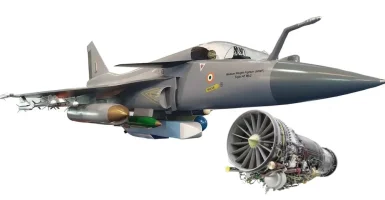
- Twisted Air Intakes: Inspired by research for the AMCA, these uniquely shaped intake ducts hide the highly reflective engine fan blades—specifically those of the powerful new GE F414-INS6 engine—from direct frontal radar scans.
- Retractable Refuelling Probe: Older design flaws have been corrected. The fixed mid-air refuelling probe used on the Mk1A has been replaced with a retractable version. This removes a major radar reflector, keeping the jet aerodynamically clean and stealthy when the probe is not required.
Radar Absorbent Coatings
To complement the physical design, the Tejas Mk2 is coated with specialised, domestically produced Radar Absorbent Materials (RAM).Innovations such as the "Adrishya-RAM" paint developed by the Council of Scientific and Industrial Research-National Aerospace Laboratories (CSIR-NAL) play a major role in the aircraft's stealth profile.
These advanced coatings are created to absorb incoming radar waves—particularly in the X-band frequencies—rather than bouncing them back to the adversary.
While these coatings alone do not make the jet invisible, their combination with the aircraft's structural shape and composite skin drastically lowers its visibility to enemy sensors.
A Competitive Edge in the Global Market
Defence analysts and program directors estimate that the Tejas Mk2 will have a frontal radar signature that is only 25% of the Mk1 variant, roughly measuring between 0.1 to 0.25 square metres.This impressive reduction places it ahead of many global 4.5-generation competitors.
While larger jets like the French Rafale and Chinese J-10C use similar stealth techniques, the Tejas Mk2 benefits from being a smaller, more compact platform.
It also holds an edge over legacy fighters like the American F-16, which were not originally built with stealth in mind, and competes directly with Sweden's Gripen E in the export market.
Unlike older jets that have stealth features added later as retrofits, the Tejas Mk2 has integrated these elements directly into its foundational design.
In modern warfare, where advanced sensor fusion and long-range missiles dominate the skies, this delayed detection gives the Mk2 a critical advantage, allowing it to strike in beyond-visual-range (BVR) combat before the enemy even knows it is there.