- Views: 28
- Replies: 1
Preliminary industry estimates suggest that India’s next-generation fighter jet, the Tejas Mk2, could cost only 23 percent more per unit than the current Tejas Mk1A.
If these projections hold true, the price of the new aircraft will remain surprisingly close to its predecessor, despite a massive leap in size, technology, and combat capability.
While this figure is not yet officially confirmed, it indicates a highly cost-effective approach to modernising the Indian Air Force.
To understand this estimate, it helps to look at the current pricing of the Tejas Mk1A.
In September 2025, the Ministry of Defence signed a ₹62,370 crore contract with Hindustan Aeronautics Limited (HAL) for 97 Tejas Mk1A jets, which included 68 single-seat fighters and 29 trainers.
This deal brought the average cost of a single Mk1A to around ₹640-650 crore, or $76-78 million.
This was roughly a 17.6 percent increase from a previous 2021 order, driven by the addition of 67 locally made systems—such as the UTTAM AESA radar and the Swayam Raksha Kavach electronic warfare suite—as well as global supply chain inflation and currency fluctuations affecting the American-made GE F404 engines.
Building on that $77-78 million baseline, a 23 percent increase would price the new Tejas Mk2 at approximately $95-96 million, or ₹790-800 crore per jet.
This is considered a modest price bump when looking at the massive upgrades the Mk2 brings.
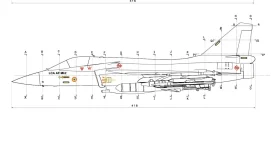
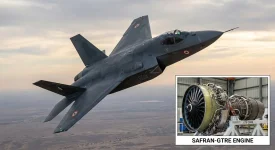
Known as the Medium Weight Fighter (MWF), the 4.5-generation Mk2 features a larger airframe equipped with close-coupled canards, a higher internal fuel capacity, and an advanced sensor suite.
Publicly available specifications confirm that the Mk2 will boast 13 weapon hardpoints capable of carrying a 6,500 kg external payload—a major step up from the Mk1A.
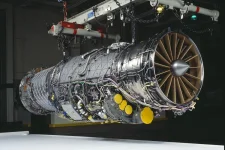
Powering this larger jet will be the General Electric F414-INS6 engine, delivering a much more powerful 98 kN of thrust.
This relatively small price difference highlights a smart development strategy.
Rather than building the Mk2 from scratch, the Defence Research and Development Organisation (DRDO), the Aeronautical Development Agency (ADA), and HAL are keeping costs down by sharing production infrastructure, suppliers, and design elements from the Mk1A programme.
The Mk2 is actively moving forward, having previously secured a ₹10,000 crore clearance from the Cabinet Committee on Security for prototype development.
Current plans include building five flying prototypes, with the first aircraft expected to be ready by the end of 2028.
Looking ahead, the broader plan to acquire 210 Mk2 jets is estimated to cost between $15.5 and $17.5 billion. This broader package easily accommodates the projected unit cost when factoring in long-term spares and lifecycle infrastructure.
Ultimately, the final price of the Tejas Mk2 will depend on a few upcoming milestones.
A major factor will be the finalisation of a technology transfer agreement for the GE F414 engine, which aims to manufacture 80 percent of the engine directly in India.
Furthermore, HAL’s ability to efficiently use its expanded production facilities in Nashik and Bengaluru to spread out initial manufacturing costs will play a crucial role.
For now, the 23 percent estimate is a promising sign that India can field a far more capable fighter jet without placing an excessive burden on the national defence budget.