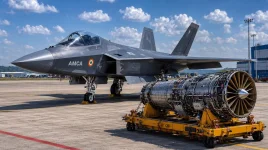
The South Korean KF-21 Boramae has swiftly proven itself as a highly capable entrant in the modern combat aviation market, officially receiving its combat-ready airworthiness certification in June 2026.
Given that it is powered by the American General Electric F414 engine—the exact same powerplant chosen for India’s upcoming Tejas Mk2 and the early variants of the Advanced Medium Combat Aircraft (AMCA)—an interesting hypothetical scenario arises: could the KF-21 step in as a viable alternative if India's 114-jet Multi-Role Fighter Aircraft (MRFA) negotiations for the Dassault Rafale were to collapse?
On paper, this idea holds some appeal. Sharing a common engine could theoretically streamline supply chains, training, and maintenance for the Indian Air Force (IAF).
However, a deeper analysis reveals that bringing the South Korean jet into the Indian ecosystem would introduce severe strategic, manufacturing, and operational roadblocks that easily overshadow the logistical perks.
A Clash of Domestic Ambitions
The most glaring obstacle is how directly the KF-21 conflicts with India’s homegrown aerospace roadmap.The IAF is currently channelling massive resources into two primary domestic projects. The Tejas Mk2 is being developed to be the backbone of India's 4.5-generation medium-weight fleet, while the AMCA is envisioned as the nation's premier fifth-generation stealth platform.
The KF-21 sits exactly in the operational space carved out for the Tejas Mk2. Like the Indian jet, the KF-21 is a twin-engine (F414), medium-weight 4.5-generation fighter equipped with modern avionics and reduced radar signature.
Because its initial configurations lack fully enclosed internal weapons bays, it operates primarily as an advanced air superiority fighter rather than a true stealth platform.
Inducting a foreign fighter that mirrors this exact profile would lead to a wasteful duplication of effort. Instead of acting as a stopgap, the KF-21 would directly siphon off the production funding, industrial capacity, and strategic focus desperately needed to mature the Tejas Mk2.
Ultimately, this would actively undermine India’s goal of nurturing a self-reliant defence manufacturing sector.
This friction extends to the AMCA project as well. India's ultimate objective is to independently master complex fifth-generation technologies, such as advanced sensor fusion and stealth engineering.
Funnelling billions into establishing a domestic assembly line for yet another imported aircraft could severely stall the financial and intellectual investments required for the AMCA.
The Complications of Export Controls and Autonomy
While sharing the F414 engine seems like a logistical victory, it brings a hidden layer of bureaucratic trouble.Because the KF-21 heavily integrates systems, engines, and technologies co-developed with American defence firms, it is strictly bound by United States export control laws.
Consequently, any major upgrades, software alterations, or future export attempts by India would require explicit clearance from Washington.
Historically, New Delhi has fiercely protected its strategic autonomy regarding military hardware. This is precisely why the French Rafale remains so attractive.
France maintains independent control over its defence exports, affording India the freedom to modify the aircraft and seamlessly integrate domestic weapons—like the Astra beyond-visual-range missile—without seeking third-party permissions.
In fact, India is reportedly aggressively advancing the MRFA deal, having prepared a formal Letter of Request (LoR) in mid-2026 for 114 Rafales, aiming to build 90 of them domestically under a ₹3.25 lakh crore agreement.
A Mismatch in Industrial Philosophy
Manufacturing philosophies present another massive hurdle.India’s modern defence strategy relies heavily on deep technology transfer and establishing robust local supply chains. The history of the KF-21 suggests that securing this level of foundational knowledge-sharing is incredibly difficult.
When South Korea initially partnered with Indonesia to fund and develop the KF-21, the venture was plagued by payment disputes and intense disagreements over how much core technology Jakarta was actually allowed to access.
While this does not guarantee identical issues with India, it highlights how tightly guarded sensitive aerospace technology remains, even among partnered nations.
Furthermore, Korea Aerospace Industries (KAI) has designed its production model around highly automated, hyper-efficient domestic factories.
Adapting this model to fit India’s strict 'Make in India' requirements for local job creation and comprehensive technology transfer would require grueling, complex negotiations that stretch far beyond the purchase of the aircraft itself.
The Reality of the Operational Timeline
Finally, the sheer urgency of the MRFA programme cannot be ignored.The initiative was launched specifically to halt the alarming drop in the IAF's active fighter squadrons. If the current Rafale path were to fail, the immediate priority would be rapid deployment, not signing up for another drawn-out developmental timeline.
In a crisis scenario, the IAF would logically pivot to platforms that can be inducted immediately.
Ramping up production of the Tejas Mk1A, accelerating the Su-30MKI upgrades, pushing the Tejas Mk2 forward, or simply buying more off-the-shelf Rafales would utilise pre-existing bases, training schools, and supply lines. Adopting the KF-21 would demand building an entirely new logistical and training infrastructure from scratch.
Final Assessment
There is no denying that the KF-21 is a spectacular engineering milestone, successfully positioning South Korea among an elite tier of aerospace powers. For nations lacking domestic fighter programs, it is a highly compelling next-generation option.However, India's trajectory is distinctly unique. The country is simultaneously fielding a domestic medium-weight fighter and funding a fifth-generation stealth project.
Because the KF-21 offers no unique capability that India isn't already building itself, while simultaneously threatening domestic funding and introducing strict export controls, it is a strategically poor fit.
If the MRFA programme takes an unexpected turn, India’s safest and most strategic bet remains doubling down on its indigenous platforms while acquiring proven, ready-to-fly fighters to fill immediate gaps.