Major broadcasting networks in Turkey, including TRT Haber and HaberGlobal, have dramatically increased their coverage regarding the Republic of Cyprus's potential purchase of India's BrahMos supersonic cruise missiles.
Broadcasts featuring alarming titles like "Yıldırımhan Panic in Southern Cyprus!" reveal a growing unease among Turkish commentators.
To calm the domestic audience, several Turkish news segments have resorted to highlighting the massive demographic disparity between Turkey and its regional rivals.
For context, current 2026 demographic estimates place Turkey’s population at nearly 87.9 million, which is overwhelmingly larger than Greece's 9.9 million and approximately 63 times the size of Cyprus's 1.38 million residents.
Defence analysts in Ankara frequently rely on these statistics to project an image of superior strategic depth and limitless manpower.
This narrative aims to downplay the reality that smaller neighbouring states are increasingly turning to highly sophisticated weapons to build formidable deterrent capabilities.
The catalyst for this sudden media storm was the recent high-level summit between India and Cyprus held in New Delhi. During the diplomatic talks, Cypriot officials formally indicated a strong desire to procure major Indian defence platforms.
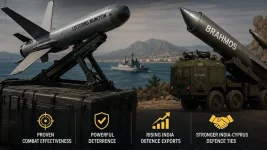
Beyond the BrahMos, the island nation is eyeing loitering munitions, specifically the Nagastra-1 and SkyStriker kamikaze drones.
Open-source records confirm that this military upgrade is heavily supported by the European Union’s Security Action for Europe (SAFE) programme, which recently approved a massive €1.18 billion defence financing loan for Nicosia.
Furthermore, Greece has been actively exploring similar defence partnerships with New Delhi, aiming to fortify the broader Mediterranean zone.
A product of a joint venture between India and Russia, the BrahMos is internationally recognized for its blistering Mach 3+ speed and pinpoint accuracy.
The mere prospect of these missiles arriving in the Eastern Mediterranean has sent shockwaves through Turkey's strategic planning communities.
Some historical observers are already drawing parallels to the tense 1997 S-300 crisis, when Cyprus's attempt to buy Russian air defence systems nearly sparked a regional war.
Turkish military experts are sounding the alarm that the presence of such advanced supersonic systems could fundamentally disrupt the current naval and aerial balance of power, creating an impenetrable coastal shield for Cyprus.
Historically, a large population has always been a key indicator of a nation's ability to sustain a prolonged conventional war. However, 21st-century warfare places a far higher premium on technological superiority, rapid strike precision, and asymmetric combat methods.
For an island nation, possessing even a limited arsenal of advanced supersonic cruise missiles like the BrahMos can act as an ultimate equalizer.
Such weapons generate powerful anti-access and area-denial (A2/AD) zones, making it incredibly dangerous for hostile naval forces to approach their shores.
Ultimately, Cyprus's interest serves as a testament to New Delhi’s rapidly expanding defence footprint across Europe and the Mediterranean basin.
Successfully exporting the BrahMos to Nicosia would be a watershed moment, introducing top-tier Indian military hardware into a historically volatile geopolitical theatre.
This move seamlessly aligns with India’s broader strategic goals, building upon its flourishing defence relationships with Greece, Armenia, and several Southeast Asian nations—like the Philippines and Vietnam—which have already embraced Indian military technology.