- Views: 2K
- Replies: 1
India is poised to greatly enhance its deep-strike capabilities as the air-launched version of the Long Range Land Attack Cruise Missile (LRLACM) moves into a critical development stage.
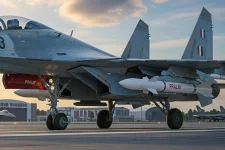
Reports indicate that efforts are currently focused on modifying the weapon for deployment from the Su-30MKI fighter jet. This aircraft is slated to be the main testing platform for the upcoming initial trial phases.
The Aeronautical Development Establishment (ADE), a prominent laboratory within the Defence Research and Development Organisation (DRDO), is spearheading this initiative.
The ADE has a strong track record in developing unmanned aerial vehicles and advanced missile systems.
This new air-launched variant is a direct evolution of the Nirbhay project, marking a significant step forward in India's family of subsonic cruise missiles.
Notably, this airborne integration follows the successful maiden flight test of the ground-launched LRLACM variant conducted off the coast of Odisha in November 2024, which was produced in partnership with Bharat Dynamics Limited (BDL) and Bharat Electronics Limited (BEL).
Technical teams are currently refining the connections between the missile and the aircraft in preparation for captive flight tests slated for later this year.
During these specific tests, the Su-30MKI will fly with the weapon attached to its wing without actually firing it.
This allows scientists to safely evaluate how the missile affects the jet's aerodynamics, monitor vibration levels, and ensure the weapon communicates flawlessly with the aircraft's internal computers and targeting systems.
In a bid to save both time and financial resources, the project utilizes the robust underwing mounting structures, or pylons, that were previously engineered for the airborne BrahMos-A missile.
By repurposing this existing hardware, engineers bypass the need for complex structural changes to the Sukhoi jets.
Because the Su-30MKI's wings were already reinforced to carry the massive BrahMos-A, the aircraft serves as a perfect, ready-made testbed for accommodating other heavy, long-distance munitions like the LRLACM.
The air-launched model differs structurally from its land and sea counterparts because it completely eliminates the need for an initial solid-rocket booster.
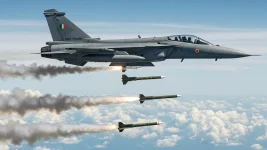
Upon release, the weapon simply drops from the aircraft. The forward momentum of the fighter jet, flying at speeds near Mach 0.6, forces enough air into the missile to ignite its internal turbofan engine, smoothly transitioning the weapon into independent, powered flight.
This power plant is the indigenous 'Manik' Small Turbo Fan Engine (STFE) developed by the Gas Turbine Research Establishment (GTRE), ensuring a high degree of self-reliance in critical propulsion technology.
As an advanced successor to the Nirbhay, the LRLACM brings substantial improvements in engine performance, navigation accuracy, and overall operational versatility.
It is engineered to perform highly accurate strikes on vital enemy infrastructure from vast distances.
To survive modern air defence networks, the missile utilizes a terrain-hugging flight profile, skimming close to the ground to stay beneath the view of enemy radar systems.
From a strategic standpoint, this new weapon bridges a vital gap in the Indian military's offensive toolkit.
While the military already relies on the supersonic BrahMos missile for rapid strikes against immediate threats, the BrahMos sacrifices distance for extreme speed.
The LRLACM, however, is designed to travel significantly further, boasting an operational range exceeding 1,000 kilometres.
Therefore, it will act as a complementary system to the BrahMos, enabling deeper penetration into enemy territory rather than serving as a direct replacement.
When fully deployed, the Indian Air Force (IAF) will gain a formidable "stand-off" weapon, meaning pilots can neutralize critical enemy assets without ever flying into hostile, heavily guarded zones.
High-priority targets like military command posts, airfields, supply chains, and radar stations can be destroyed from afar.
Fighter jets carrying the LRLACM will have the luxury of releasing their payloads from the safety of Indian airspace or securely outside the reach of adversary anti-aircraft batteries.
A distinct benefit of this airborne missile is its adaptability to various types of fighter jets.
Although the Su-30MKI is the initial testing platform, the LRLACM's lighter weight makes it a strong candidate for future integration onto other jets, such as the indigenous Tejas Mk2 or the French-made Rafale.
Naturally, bringing the weapon to these newer platforms would require technical coordination and software integration agreements with the respective aircraft manufacturers.
Finally, because subsonic cruise missiles are generally more affordable to produce than their supersonic counterparts, the IAF could feasibly stockpile and deploy the LRLACM in massive quantities.
This affordability paves the way for "swarm" or saturation tactics, where dozens of missiles are fired at once to intentionally overwhelm the computer processing and interceptor limits of top-tier enemy air defence shields, such as the S-300 or HQ-9 surface-to-air missile systems.