- Views: 2K
- Replies: 5
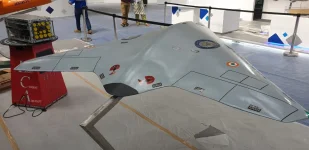
The Defence Research and Development Organisation (DRDO) is working on a highly advanced structural design for India's upcoming Ghatak stealth drone.
Sources close to the project indicate that this 13-tonne flying-wing Unmanned Combat Aerial Vehicle (UCAV) will rely extensively on modern materials.
Specifically, an estimated 80 to 90 percent of its outer shell will be constructed from carbon-fibre prepreg composites, providing the foundation for its radar-evading capabilities.
Designing for Deep-Strike Stealth
Intended for deep-strike missions, the Ghatak is built to slip through heavily protected airspace undetected while carrying a substantial amount of weapons internally.By using these advanced lightweight composites, engineers can ensure the drone remains agile and aerodynamically efficient without compromising the low radar signature inherent to a tailless, flying-wing shape.
Carbon-fibre prepreg is a favourite in modern aerospace manufacturing because it is exceptionally strong yet very light, and it can be easily shaped into intricate forms.
For the Ghatak drone, this material allows for a completely seamless and contoured exterior. A smooth surface free of bumps, joints, or gaps is vital for stealth, as it scatters radar waves and significantly lowers the aircraft's visibility to enemy detection systems.
The drone's "flying-wing" profile—meaning it has no distinct fuselage or tail section—drastically reduces its radar cross-section while simultaneously boosting its flight efficiency, a method used by top-tier stealth aircraft worldwide.
Furthermore, fabricating large, single-piece structural components out of carbon composites minimises the need for metal fasteners, screws, or seams, which bolsters both the physical strength of the drone and its stealth profile.
Next-Generation Materials
Pushing the boundaries of material science, DRDO is also integrating next-generation reinforcements to maximise strength without adding excess bulk.A major breakthrough is the application of epoxy resins enriched with carbon nanotubes (CNTs). These microscopic tubes drastically increase the overall toughness, stiffness, and durability of the airframe with almost no weight penalty.
Consequently, the Ghatak will be sturdy enough to carry an internal payload of up to 1.5 tonnes of precision-guided munitions over long distances, all while maintaining excellent aerodynamic performance.
This application of carbon nanotube technology mirrors the materials being researched for India’s upcoming fifth-generation fighter jet, the Advanced Medium Combat Aircraft (AMCA).
This overlap highlights a unified approach to developing technology for both manned and unmanned future defence platforms.
Because the Ghatak will travel at high-subsonic speeds (around Mach 0.9), it will generate significant heat. To handle this, particularly around the engine bay, the design incorporates Bismaleimide (BMI) resin composites.
Unlike standard epoxies, BMI materials can safely endure temperatures upwards of 200°C, protecting the airframe from both the engine's intense exhaust and the friction of high-speed flight.
Real-Time Structural Monitoring
The Ghatak will also feature an advanced Structural Health Monitoring (SHM) system.Following successful trials in recent years, engineers have embedded fibre-optic sensors directly into the composite materials.
These internal sensors act like a nervous system, constantly checking the aircraft for stress, fatigue, or damage in real time.
By identifying potential structural issues before they cause a failure, this technology greatly increases the reliability and safety of the drone during long, autonomous missions deep into hostile territory—a capability usually reserved for the most advanced fifth- and sixth-generation aircraft.
Programme Milestones and Approvals
The progress on the Ghatak project has yielded major administrative backing.In March 2026, the Defence Procurement Board (DPB) officially recommended the purchase of 60 Ghatak UCAVs for the Indian military.
This endorsement signals that the crucial technologies behind the drone—especially its innovative composite airframe—have successfully met strict evaluation standards.
Recent open-source reports highlight that the drone will be powered by a dry variant of the indigenous Kaveri engine, generating approximately 52 kN of thrust.
The success of the smaller Stealth Wing Flying Testbed (SWiFT) demonstrator, which completed autonomous take-off and landing trials between 2022 and 2023, thoroughly validated the complex flight control systems required for this tailless design.
The project now awaits final prototype development clearance from the Cabinet Committee on Security (CCS).
Projected Specifications of the Ghatak UCAV
| Feature | Specification |
|---|---|
| Max Take-Off Weight | 13 Tonnes |
| Internal Payload Capacity | ~1.5 Tonnes |
| Top Speed | High-Subsonic (~Mach 0.9) |
| Airframe Material | 80-90% Carbon Prepreg Composite |
| Propulsion | Dry Kaveri Engine (Non-afterburning) |