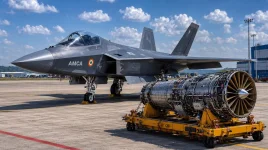
The Tejas Mk2 is poised to be much more than just a stretched, upgraded iteration of the Tejas Mk1A.
Currently under development as India's premier Medium Weight Fighter (MWF), the Mk2 introduces a fundamental shift in combat capability.
At the heart of this transformation is its expanded 11-hardpoint weapon architecture, a notable upgrade from the eight stations found on the Mk1A.
While adding three extra hardpoints might sound modest on paper, this expansion dramatically enhances the fighter’s combat versatility, eliminating the severe payload compromises pilots often face in lighter aircraft.
Tejas Mk1A: A Capable but Payload-Limited Fighter
The current Tejas Mk1A is a highly optimized light multirole jet equipped with eight external hardpoints.These include two wingtip stations dedicated to close-combat air-to-air missiles and six underwing pylons reserved for a mix of beyond-visual-range (BVR) missiles, bombs, drop tanks, and electronic warfare (EW) or targeting pods.
While the Mk1A effectively handles air defence and precision strike roles with a maximum external payload of roughly 5.3 tonnes, its compact size dictates strict operational trade-offs.
For instance, equipping the jet with extra external fuel tanks to extend its flying range directly reduces the number of stations available for offensive weapons or crucial mission pods.
The Tejas Mk2 Advantage: More Hardpoints, Heavier Payload
To overcome these structural limitations, the Tejas Mk2 expands the weapon station layout to 11 hardpoints.The new configuration retains the two wingtip stations but increases the underwing pylons to eight (four under each wing) and adds a dedicated centerline hardpoint beneath the fuselage.
This expanded layout is supported by a more robust canard-delta airframe and the integration of the powerful General Electric F414-INS6 engine, which produces 98 kN of thrust.
Because of these structural and propulsion upgrades, the Mk2’s maximum external payload jumps to roughly 6.5 tonnes—over a tonne more than its predecessor.
Overall, the maximum take-off weight (MTOW) of the aircraft is pushed to approximately 17.5 tonnes, firmly placing it in the medium-weight fighter category.
"Carry Everything" Mission Flexibility
With these extra stations, the Tejas Mk2 offers a "carry everything at once" philosophy, drastically reducing the operational compromises typical of single-engine light fighters.During an air superiority mission, the Mk2 can comfortably carry several BVR missiles—such as the indigenous Astra—alongside wingtip close-combat missiles, heavy drop tanks, and advanced electronic warfare pods.
Similarly, for a ground strike mission, the aircraft can maintain a full load of self-defence missiles while simultaneously packing heavy precision-guided munitions, long-range glide bombs, and additional fuel.
Official configuration models of the Tejas Mk2 illustrate a formidable heavy-load scenario. The jet can carry two wingtip air-to-air missiles, two 250 kg-class precision weapons, two 800 kg-class heavy stores, multiple 1,800 kg-class fuel tanks, and an additional centerline store.
Replicating this heavily armed and fueled configuration would be virtually impossible on the Mk1A without making major sacrifices to either range or firepower.
Dominance in Air-to-Air and SEAD Operations
The 11-hardpoint architecture heavily bolsters the Mk2's air dominance capabilities.Coupled with the advanced indigenous Uttam Active Electronically Scanned Array (AESA) radar, the fighter can carry a significantly larger arsenal of air-to-air missiles while retaining external fuel tanks for prolonged combat patrols.
This means more engagement opportunities and greater endurance during a single sortie.
This flexibility is even more critical for strike and SEAD (Suppression of Enemy Air Defences) missions. The Mk2 can be fully loaded with precision bombs, stand-off weapons, targeting and EW pods, and self-defence missiles all at once.
With the planned integration of next-generation indigenous weapons like the Rudram anti-radiation missiles and the BrahMos-NG cruise missile, the Mk2 becomes a highly lethal platform for deep penetration and maritime strikes.
A Platform Built for the Future
Beyond its immediate tactical benefits, the Tejas Mk2’s expanded payload architecture provides vital room for future growth.As India continues to develop heavier smart weapons, longer-range missiles, and more complex electronic warfare systems, the Mk2 offers the physical space and payload capacity to adopt them seamlessly without severe operational penalties.
Backed by enhanced internal fuel capacity, a larger airframe, and superior engine thrust, the 11-hardpoint design ensures the Tejas Mk2 is not just a modest upgrade, but a true medium-weight multirole fighter built to secure India's skies for decades to come.