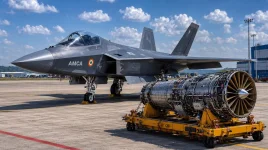
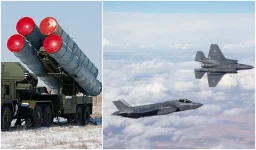
With New Delhi moving forward on its ambitious Advanced Medium Combat Aircraft (AMCA) Mk2 project, multiple international aerospace giants are eager to co-develop the required 110–130 kN thrust class engine.
While prominent players such as France's Safran, Britain's Rolls-Royce, and America's GE Aerospace are openly vying for this strategic partnership, Pratt & Whitney (P&W)—a global leader in military aviation engines—has noticeably stayed away from the competition.
The renowned manufacturer behind the powerplants for the F-22 Raptor and F-35 Lightning II has made no public effort to bid for the Indian fighter jet requirement.
This strategic distance is not due to a single issue. Instead, it stems from a complex mix of strict export regulations, current corporate commitments, United States government policies, and recent industrial hurdles.
A primary hurdle is the sheer depth of technology New Delhi is demanding. For the AMCA Mk2, India is not simply looking to buy ready-made engines; it insists on complete co-development, domestic manufacturing, and a comprehensive transfer of technology.
Indian authorities have made it clear that any new partnership must move past traditional licensed assembly, granting local engineers access to crucial design expertise to build up the nation's independent gas turbine industry.
Fulfilling these sweeping demands would be incredibly challenging for Pratt & Whitney.
The firm's premier military products, such as the F119 for the F-22 and the F135 for the F-35, are packed with some of America's most highly classified propulsion advancements.
These include state-of-the-art thermal management, specialized high-temperature materials, cutting-edge turbine blade metallurgy, digital flight control software, and stealth integration techniques.
Such breakthroughs are heavily guarded by the US International Traffic in Arms Regulations (ITAR) and various national security protocols.
Sharing the core intellectual property of these advanced systems requires explicit permission from Washington, which fiercely protects any technology deemed vital to its national defence.
Although future technology agreements rely on evolving US policies, there are currently no signs that the American government is willing to share the foundational design secrets of the F119 or F135 engines with any foreign ally, including India.
The current landscape of the India-US defence partnership also shapes Pratt & Whitney's position.
Over the last ten years, GE Aerospace has firmly established itself as the leading American provider of combat aircraft engines for New Delhi.
GE currently supplies the F404 engine for the Tejas Mk1 and Mk1A fleets, and recently secured a landmark deal to locally manufacture the F414 engine for the Tejas Mk2 and the first wave of AMCA Mk1 fighters.
This deepening industrial tie has effectively made GE the preferred US propulsion partner for Indian military aviation. The recent manufacturing agreements, forged under the wider strategic alliance between the two nations, have cemented GE's dominance within the Indian aerospace sector.
While the US government has not publicly banned Pratt & Whitney from bidding on upcoming Indian projects, GE’s deeply rooted manufacturing footprint in India provides it with a massive head start in securing future defence contracts with New Delhi.
Recently, GE's F414 engine cost has reportedly tripled during commercial negotiations, prompting India to look closely at other global vendors for the Mk2, yet GE remains America's frontline contender for current phases.
Internal business challenges are another major reason for Pratt & Whitney's hesitance.
The manufacturer has recently been consumed by one of the most severe commercial aviation crises it has ever faced.
A flaw involving contaminated powdered metal in the PW1100G Geared Turbofan (GTF) engines triggered global fleet inspections, rapid maintenance cycles, and the grounding of hundreds of Airbus A320neo aircraft.
This massive defect deeply impacted airlines worldwide, particularly in India, where major carriers like IndiGo saw upwards of 70 aircraft grounded due to GTF snags.
The crisis forced Pratt & Whitney and its parent corporation, RTX, to pour billions of dollars and vast engineering resources into fixing the engines, making the GTF recovery the company’s top operational focus.
Simultaneously, the company carries a massive workload sustaining the worldwide F-35 fighter fleet.
Engineers at P&W are currently focused on the F135 Engine Core Upgrade (ECU), a project designed to boost the thermal management, cooling, and overall power of the F-35 to support new weapons and sensors.
With the global F-35 fleet projected to surpass 3,000 jets, fulfilling this requirement remains one of the largest and most demanding military engine contracts in history.
Satisfying the needs of the Pentagon and allied militaries consumes immense manufacturing bandwidth and capital. Therefore, embarking on a brand-new, fifth-generation engine co-development project for a foreign nation would demand spare resources and a long-term focus that the company currently lacks.
For India, selecting a partner for this critical project goes well beyond thrust and fuel metrics.
The AMCA Mk2 demands an engine in the 110–130 kN thrust range that can deliver supercruise speeds, seamless stealth integration, exceptional fuel economy, and durability.
Just as crucially, New Delhi is demanding total involvement in the engine's architectural design, manufacturing processes, and future iterations—far beyond what standard licensed manufacturing deals allow.
This strategic goal makes joint-development models far more attractive to India than traditional off-the-shelf purchases.
To meet these requirements, France's Safran has established a joint venture framework with India's DRDO to co-develop a 120 kN engine.
Meanwhile, the UK's Rolls-Royce has aggressively pitched a clean-sheet 110–130 kN engine, promising complete transfer of intellectual property (IP) rights and local development by 2032. Russia’s United Engine Corporation has also floated offers for future combat aircraft propulsion.
While these competing bids vary in their exact offerings regarding IP ownership, technology sharing, and local industrial integration, they all acknowledge one fundamental truth: India's procurement standards have permanently shifted from mere buying to sovereign co-creation.
In the end, Pratt & Whitney's missing bid for the AMCA Mk2 is not due to a shortfall in technological prowess, but rather a perfect storm of external and internal constraints.
The rigid US export laws guarding its top-tier military technology, combined with GE Aerospace's entrenched dominance in India, massive commercial GTF liabilities, and heavy F-35 obligations, leave the company with little strategic appetite or operational bandwidth to take on a complex, long-term joint venture with India.
- Read in Other Language
- Hindi (हिंदी)