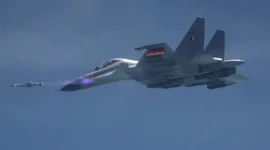
Recent reports suggesting that the Royal Saudi Air Force is eyeing India's Astra Mk1 beyond-visual-range air-to-air missile (BVRAAM) for its fleet of F-15 fighter jets have sparked widespread interest.
If this deal materialises, it would be a monumental achievement for India’s defence export sector. It would potentially make the Astra Mk1 the first indigenous Indian air-to-air missile to be armed on a frontline Western combat aircraft.
However, while the business prospect looks highly promising, actually fitting this weapon onto Saudi F-15s involves hurdles that go far beyond a simple purchase agreement.
Behind the scenes, defence ties between New Delhi and Riyadh are deepening across various military sectors, with the Astra missile taking centre stage in recent talks.
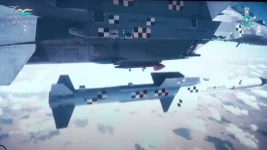
Developed by India's Defence Research and Development Organisation (DRDO), the Astra Mk1 boasts a strike range of up to 110 kilometres and operates at speeds reaching Mach 4.5.
Its modern tracking capabilities and cost-effectiveness make it a highly competitive alternative to pricier Western missiles. From a diplomatic and trade perspective, there are no roadblocks for India to pitch the weapon.
New Delhi is aggressively pushing its home-grown military technology on the global market, while Saudi Arabia is actively looking to diversify its defence suppliers as part of its Vision 2030 strategy. These mutual goals make initial trade discussions very practical.
The real challenge lies in the physical and digital integration of the missile onto Saudi Arabia’s advanced Boeing-manufactured fighters, specifically the F-15S and the highly upgraded F-15SA (Saudi Advanced) variants.
From a strict engineering standpoint, linking a new weapon to a modern jet is entirely possible. Combat aircraft are designed to carry various payloads, provided that the necessary software updates, launcher tweaks, and flight tests are completed.
The main issue is not whether engineers can make it work, but whether they have the legal right and practical access to do so.
Because the F-15 is an American aircraft, the final say rests heavily with the United States. The jet’s core systems—such as its mission computers, radar interfaces, and weapon release software—run on highly classified and protected American technology.
Launching a beyond-visual-range missile requires the aircraft’s radar to detect a target, share complex data with the missile in mid-air, and safely release the weapon. This requires the missile to flawlessly communicate with the jet's central brain.
Accessing the digital blueprints needed to make this connection is strictly restricted by the United States’ International Traffic in Arms Regulations (ITAR).
Neither India nor Saudi Arabia holds the keys to the F-15’s proprietary source code to plug in a foreign missile independently. Furthermore, Boeing, the original manufacturer of the F-15, plays a mandatory role.
Safely arming a jet with a new missile requires rigorous structural checks, aerodynamic studies, wind tunnel tests, and live-fire certifications. Without Boeing’s direct involvement and technical support, clearing the Astra Mk1 for safe use on the F-15 is virtually impossible.
The legal hurdles present an even steeper climb. The majority of Saudi Arabia’s sophisticated F-15SA jets were purchased through the U.S. Foreign Military Sales (FMS) programme.
Aircraft bought under this scheme are tightly governed by End-Use Monitoring (EUM) rules, which strictly control any third-party modifications or software tampering.
If Riyadh attempted to wire the Astra Mk1 into the F-15 without official clearance from Washington, it would violate these international agreements.
Doing so could result in the U.S. cutting off critical maintenance support, spare parts, and future software upgrades, effectively grounding the backbone of the Saudi Air Force.
Ultimately, any effort to pair the Indian Astra Mk1 with the Saudi F-15 fleet requires a formal green light from Washington, alongside Boeing's engineering expertise.
The U.S. government would need to issue special export licences and approve the necessary software changes.
While this sounds daunting, it is not without precedent. The U.S. has previously permitted allied nations to integrate non-American weapons onto U.S.-made jets when it aligns with shared strategic goals.
Therefore, if Saudi Arabia is serious about arming its F-15s with the Astra Mk1, the project can no longer just be a bilateral trade deal between New Delhi and Riyadh. It must evolve into a complex, trilateral partnership heavily reliant on American approval.
- Read in Other Language
- हिंदी (Hindi)