The Indian Navy is taking a major step to enhance its covert underwater capabilities by initiating discussions to acquire two midget submarines.
These highly specialized vessels are specifically meant for the Marine Commandos (MARCOS), India's elite naval special forces.
This development revives a long-standing operational requirement to strengthen maritime security and special operations in shallow, coastal waters where standard submarines cannot safely navigate.
Often classified as Special Operations Vessels (SOVs) or Swimmer Delivery Vehicles (SDVs), these compact submarines are tailor-made for high-risk, classified missions.
They allow commandos to approach enemy coastlines completely undetected, launch underwater sabotage missions, gather critical intelligence, and safely extract the team.
For a specialized unit like MARCOS, which handles maritime counter-terrorism and amphibious warfare, these platforms are vital for closing a significant gap in the Navy's shallow-water combat readiness.
To secure the best available technology, the Navy is holding talks with both domestic heavyweights and international shipbuilders.
On the domestic front, Mazagon Dock Shipbuilders Limited (MDL) and Larsen & Toubro (L&T) are leading the charge.
MDL has been working on its indigenous 'Arowana' midget submarine prototype, while L&T has heavily invested in its SOV-400 design, a 400-tonne vessel capable of deploying swimmer delivery vehicles.
Concurrently, the Navy is evaluating European alternatives, specifically engaging Italian shipbuilders like Drass and Fincantieri. Both European firms have a deeply established history and proven expertise in manufacturing naval special operations craft.
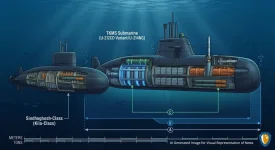
Unlike the Navy's massive conventional attack submarines—such as the Scorpene class—these midget variants are significantly smaller, typically displacing between 150 and 550 tonnes.
Despite their small physical footprint, they are packed with advanced stealth technology, modern sensors, and ultra-quiet propulsion systems.
A standard midget submarine in this category is built to transport its primary crew alongside a highly armed team of 8 to 20 special forces operators.
Their size makes them exceptionally agile in confined littoral zones and incredibly difficult for enemy sonar to detect.
The necessity for such specialized vessels was first identified almost two decades ago, gaining severe urgency in the aftermath of the 2008 Mumbai terror attacks.
Past procurement efforts, including a global tender in 2009 and a subsequent proposed project with Hindustan Shipyard Limited, ultimately stalled due to design complexities and partnership hurdles.
Today, driven by the broader 'Atmanirbhar Bharat' (Self-Reliant India) initiative, the Ministry of Defence is pushing aggressively to finalize this acquisition.
Defence experts consider these submarines a strategic necessity, providing an asymmetric advantage to secure India’s vast coastline and strategically critical island territories like the Andaman and Nicobar archipelago.
As negotiations move forward, the Ministry of Defence will need to determine the final acquisition route.
The government must decide whether to build the vessels entirely at home under the 'Buy (Indian-IDDM)' procurement category, or to partner with a European firm to bridge any existing technology gaps through a localized manufacturing agreement.
While the immediate procurement is limited to just two submarines, this initial contract is expected to lay the groundwork for a much larger fleet.
If successful, the Indian Navy is projected to order at least five more of these covert platforms in the coming years.