The race to develop India's next-generation unmanned combat aircraft is heating up, with two distinct Collaborative Combat Aircraft (CCA) initiatives emerging.
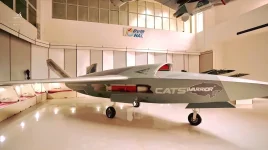
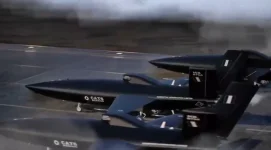
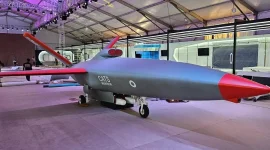
Hindustan Aeronautics Limited (HAL), the state-owned aerospace manufacturer, is progressing with its CATS Warrior platform.
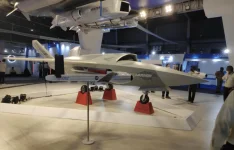
Simultaneously, Hyderabad-based private deep-tech firm Paninian India is constructing the Swayatt-M1, its own autonomous aerial system.
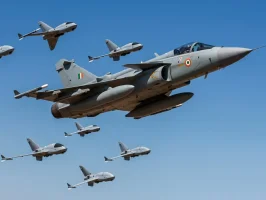
While both drones are envisioned to act as "loyal wingmen" supporting manned fighter jets in combat, they employ vastly different design concepts and strategic functions.
The Heavyweight: HAL's CATS Warrior
HAL's drone belongs to the comprehensive Combat Air Teaming System (CATS) initiative, a broader strategy to create interconnected unmanned systems that team up with human-piloted aircraft.The CATS Warrior has progressed to the prototype phase, having notably completed critical engine ground runs and structural tests with industry partners like Tata Elxsi over the past year.
Ground trials are currently underway to perfect its low-observable radar-absorbent material (RAM) coatings and flight control software. First flight expectations have shifted slightly from late 2026 to 2027 to accommodate these intricate technical refinements.
Functioning effectively as a scaled-down fighter jet, the CATS Warrior is a heavy-class platform projected to weigh in the two-to-three-ton range.
It is built to escort frontline aircraft like the Tejas Mk1A, Su-30MKI, and Rafale deep into hostile territory.
Capable of reaching subsonic speeds of up to Mach 0.9, it boasts a substantial payload capacity of roughly 650 kilograms distributed across internal and external bays.
The drone is intended to unleash formidable munitions, including the Smart Anti-Airfield Weapon (SAAW) and Astra Mk2 missiles, and can even release up to 24 ALFA-S swarm drones mid-air, making it a severe force multiplier.
For propulsion, current CATS Warrior prototypes utilise twin PTAE-W (an evolution of the PTAE-7) turbojet engines, initially conceptualised for target drones.
While these engines supply adequate power for initial testing phases and ground runs, they restrict the platform's maximum endurance.
To unlock its full combat range and performance, HAL intends to eventually transition the drone to the more powerful, indigenous HTFE-25 turbofan engine currently under development.
The Agile Contender: Paninian's Swayatt-M1
Taking a starkly different development path, Paninian India’s Swayatt-M1 prioritises agility, cost-effectiveness, and rapid adaptability over heavy strike capabilities.Slated for its maiden flight between 2027 and 2028, this medium-weight drone relies on a highly modular, "plug-and-play" architecture.
Instead of carrying heavy bombs, the Swayatt-M1 is tailored for versatile tactical payloads.
Operators can quickly interchange packages for intelligence, surveillance, and reconnaissance (ISR), advanced electronic warfare (EW), or decoy missions, allowing the drone to seamlessly switch between forward sensing and suppressing enemy air defences.
The Swayatt-M1 will draw power from the domestically produced Yantur engine series, which offers thrust profiles varying from 3 to 12 kilonewtons.
Paninian has heavily leveraged modern digital engineering, utilizing complex "digital twin" simulations to perfect the airframe's aerodynamics and engine efficiency long before physical production.
This advanced methodology is intended to yield a superior thrust-to-weight ratio, equipping the aircraft to execute high-G manoeuvres and aggressive flight patterns.
The Software Battle: Manned Control vs. Total Autonomy
Both platforms rely heavily on artificial intelligence, yet their software approaches diverge significantly:- HAL's ACID System: The CATS Warrior integrates the Air Combat Intelligence Development (ACID) algorithm, a system explicitly tuned for manned-unmanned teaming (MUM-T). This architecture ensures secure data links directly into the cockpits of manned fighters, allowing human pilots to direct multiple drones simultaneously.
- Paninian's Kalman Intel AI: Conversely, the Swayatt-M1 runs on a proprietary AI platform. The startup highlights this system's exceptional autonomous decision-making capacity, which enables the drone to independently navigate, assess threats, and execute mission parameters even in GPS-denied environments or when enemy electronic warfare severs its connection to human operators.
A Layered Defence Ecosystem
Naturally, HAL’s massive state-backed CATS Warrior has dominated headlines. However, Paninian’s Swayatt initiative has steadily built momentum in the background.The deep-tech startup has capitalised on government innovation schemes like the Acing Development of Innovative Technologies with iDEX (ADITI) and Innovations for Defence Excellence.
Furthermore, Paninian has strategically partnered with established industrial giants, including Godrej Aerospace, to manufacture its propulsion systems.
Ultimately, defence experts suggest that the Indian Air Force might integrate both platforms into a comprehensive, multi-tiered unmanned fleet.
In such an operational ecosystem, the CATS Warrior would act as the heavy-hitting strike and escort asset thrusting deep into contested skies alongside manned fighters, while the Swayatt-M1 would serve as the agile, cost-effective vanguard for electronic warfare and surveillance.