- Views: 3K
- Replies: 11
Unmanned aerial vehicles have shifted from being specialised military assets to the primary force multipliers along the volatile borders between India and Pakistan.
As both nations rush to adopt First Person View (FPV) drones, loitering munitions, and swarm technologies, the Indian Army has secured a commanding lead.
Driven by robust domestic research and a booming private sector, India is rapidly scaling its unmanned operations, establishing a level of self-reliance and tactical superiority that far outpaces its neighbour.
A Revolutionary Surge in Unmanned Capabilities
The momentum of India's drone integration is unprecedented.In early April 2026, the military released a comprehensive Technology Roadmap for Unmanned Aerial Systems and Loitering Munitions.
This blueprint targets the acquisition of 30 distinct drone variants, encompassing everything from heavy-lift cargo UAVs to low-cost suicide drones and advanced surveillance swarms.
To meet this strategic goal, the Army plans to deploy tens of thousands of locally manufactured drones over the next half-decade—a procurement scale never before seen in the region.
Emergency purchases have already yielded significant battlefield dividends.
Gujarat-based InsideFPV recently delivered kamikaze systems specifically engineered to withstand the freezing -35°C temperatures of high-altitude frontiers like Ladakh and Siachen.
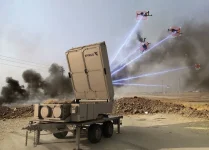
Concurrently, Droneyards has provided robust FPV units capable of navigating heavily contested airspace saturated with electronic warfare (EW) jamming.
The success of recent tactical initiatives, such as Operation Sindoor, has further accelerated these deployments.
For instance, systems like IG Drones’ Striker FPV have successfully completed rigorous combat-readiness trials along the Line of Actual Control.
The Power of India’s defence Ecosystem
The true differentiator for India is the highly effective collaboration between government agencies and commercial enterprises.Foundational technologies developed by the Defence Research and Development Organisation (DRDO) are quickly being transformed into field-ready equipment by agile startups and major defence corporations.
Industry leaders like IdeaForge—a pioneer in Indian UAVs—alongside NewSpace Research & Technologies, Adani defence, InsideFPV, and IG Drones, have been awarded multi-crore contracts.
This equipment spans from vertical take-off and landing (VTOL) units to complex, autonomous swarm systems.
To support this hardware influx, the Army has initiated a massive human resources push.
Over 100,000 drone operators have already been trained, and with 19 specialised training hubs slated for completion by late 2026, the military aims to make basic drone operation a universal skill for soldiers by 2027.
Furthermore, recent domestic orders exceeding ₹5,000 crore highlight a strict adherence to the Aatmanirbhar Bharat initiative, ensuring supply chains remain entirely free of Chinese components.
Pakistan’s Strategic Bottlenecks
Across the border, Pakistan’s approach to unmanned warfare presents a stark contrast, relying heavily on foreign imports and basic local assembly.While the Pakistani military has showcased VTOL and FPV capabilities during drills like Exercise Maiden Strike, its core fleet remains built on foreign designs.
This includes a notable inventory of Chinese CH-4 and Wing Loong drones, as well as the Turkish Bayraktar TB2, supplemented by domestically assembled Shahpar and Burraq models.
However, the scale of Pakistan's fleet is estimated to be roughly one-third the size of India's in critical categories.
By relying on cost-effective Chinese imports, Pakistan can adapt its tactics quickly, but it leaves itself exposed to major supply chain disruptions and a lack of domestic manufacturing depth in the event of a prolonged conflict.
The Qualitative Leap
While Pakistani forces demonstrate tactical innovation with FPVs and kamikaze units at the squad level, they fundamentally lack the robust industrial ecosystem driving India's progress.Pakistani manufacturers remain heavily tied to imported sensors, engines, and core components.
In contrast, India's defence corridors—bolstered by government Production-Linked Incentive (PLI) schemes—allow companies like Surat-based InsideFPV and swarm-pioneers NewSpace to deliver emergency batches of advanced munitions in a matter of weeks.
This public-private synergy has given India not just a massive numerical advantage, but a distinct qualitative leap.
Indian FPV and kamikaze platforms now routinely feature domestic thermal imaging, night-vision capabilities, and advanced electronic warfare resistance, ensuring the Indian Army maintains a decisive, future-proof edge on the modern battlefield.