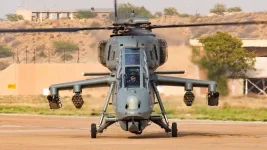
India’s Light Combat Helicopter (LCH) Prachand, engineered by Hindustan Aeronautics Limited (HAL), has already proven its mettle as the only attack helicopter globally capable of taking off and landing at extreme altitudes of 5,000 metres.
While it currently serves the Indian Army and Air Force in hot-and-high environments, the evolving nature of warfare presents a new challenge: the rapid proliferation of hostile drones.
From inexpensive drone swarms to larger loitering munitions, unmanned aerial vehicles (UAVs) are fundamentally reshaping combat.
Consequently, defence experts are exploring how the Prachand can be repurposed as a formidable Counter-Unmanned Aerial System (C-UAS).
By leveraging its current arsenal—including its chin-mounted 20mm cannon, the advanced Elbit CoMPASS sensor suite, and 70mm laser-guided rockets—the helicopter is exceptionally well-positioned to take on this modern threat.
Advanced Detection and Target Tracking
Successfully defeating a drone relies heavily on early detection and precise tracking.The Prachand is equipped with the Elbit CoMPASS electro-optical/infrared (EO/IR) turret, which is manufactured domestically by Bharat Electronics Limited (BEL).
This advanced system provides high-resolution, day-and-night visual surveillance, automatic target tracking, and precise laser designation.
It is highly effective at spotting small, agile aerial targets from a distance, giving the crew a clear and immediate picture of the battlefield.
When paired with the pilots' helmet-mounted sights, the system enables the crew to lock onto fast-moving drones instantly, ensuring a rapid and accurate response in heavily contested airspace.
Close-Range Defence with the 20mm Autocannon
When drones breach the outer defensive perimeter, the LCH relies on its Nexter THL-20 turret for close-in protection.This lightweight, belt-fed 20mm M621 autocannon can unleash up to 800 rounds per minute, effectively striking targets up to two kilometres away.
During trials, the weapon has demonstrated remarkable precision in air-to-air scenarios.
Against small Class I and II drones, which are frequently used in swarm attacks, the cannon’s rapid rate of fire and fragmentation rounds generate a concentrated, lethal zone of shrapnel.
Slaved directly to the helmet display and EO suite, the gun automatically tracks where the pilot looks, allowing the helicopter to actively hunt down close-range drones even while performing evasive manoeuvres.
Long-Range Precision with Laser-Guided Rockets
For threats located further away, the Prachand’s capacity to carry up to 48 Thales FZ275 70mm Laser-Guided Rockets (LGRs) offers a distinct tactical advantage.These semi-active laser-guided munitions can strike targets up to seven kilometres away with pinpoint accuracy, boasting a circular error probable of just one metre at a six-kilometre range.
The 4.1 kg warhead effectively bridges the gap between close-range cannon fire and highly expensive long-range missiles.
Armed with airburst fragmentation warheads, these rockets are uniquely suited for neutralising UAVs—similar to how international forces combat Shahed-style drones—by scattering thousands of lethal pellets to ensure a kill, even on a near-miss.
Recent developments also highlight that these critical rockets are increasingly being manufactured domestically under 'Make in India' initiatives through partnerships between Thales, Bharat Dynamics Limited (BDL), and Adani Defence.
A Layered Aerial Shield and Future Upgrades
By combining these systems, the LCH Prachand offers a comprehensive, multi-layered defence against unmanned threats.It can detect and designate targets using the CoMPASS suite, engage at a safe distance with FZ275 rockets, and eliminate close-in threats with its 20mm cannon.
Alongside the already integrated MBDA Mistral-2 air-to-air missiles, this configuration allows the helicopter to shield forward bases, escort armoured columns, and intercept drone swarms over difficult mountainous terrain where ground-based radars often struggle with line-of-sight limitations.
While initially built for anti-armour and close air support, the Prachand’s operational scope is rapidly expanding.
The Indian Ministry of Defence recently approved a massive order for 156 additional LCH units, underscoring the platform's strategic value.
Furthermore, the Indian military's recent DISC-14 initiative, launched in March 2026, specifically calls on the private sector to develop dedicated, helicopter-mounted electronic warfare and jamming systems to protect aircraft like the Prachand from First-Person View (FPV) and kamikaze drones.
Because the helicopter is an indigenous platform, integrating these new software updates, specialised anti-UAS warheads, and airborne jammers can be achieved far faster than with imported aircraft, cementing the Prachand's future as India's premier aerial "drone hunter."