- Views: 3K
- Replies: 4
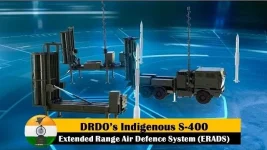
The Defence Research and Development Organisation (DRDO) is advancing Project Kusha, officially known as the Extended Range Air Defence System (ERADS).
This domestic programme is fast emerging as a powerful, indigenous alternative to the Russian S-400 Triumf.
Sources indicate that the system has been fundamentally designed to eliminate reliance on foreign suppliers, delivering similar operational ranges while offering unmatched benefits in terms of national sovereignty, lower costs, and long-term sustainability.
Open-source data suggests that Kusha boasts an impressive single-shot kill probability of over 80% and is preparing for phased induction between 2028 and 2030.
A Breakthrough in Cost Efficiency
The financial savings associated with this indigenous project are immense.To put this in perspective, India acquired five squadrons of the Russian S-400 for roughly $5.43 billion (around ₹45,000 crore).
In stark contrast, the Indian Air Force's planned procurement of five Project Kusha squadrons has been cleared for an estimated ₹21,700 crore ($2.6 billion).
This remarkable difference practically cuts the capital expenditure in half, saving valuable national resources in an inherently expensive sector.
This affordability is not limited to the initial purchase; it fundamentally extends to the missiles themselves.
Project Kusha utilizes a layered shield consisting of three interceptor variants: the M1 (approx. 150 km range), M2 (approx. 250 km range), and the heavy M3 (350–400 km range).
Each of these missiles is projected to cost between ₹40 to ₹50 crore, which is almost 50% cheaper than equivalent Russian interceptors.
This is made possible by a robust domestic supply chain, with Bharat Electronics Limited (BEL) manufacturing the advanced Multi-Function Control Radars and Bharat Dynamics Limited (BDL) producing the missiles, which feature highly effective dual-pulse solid rocket motors.
Absolute Software and Tactical Independence
Beyond monetary savings, the most crucial benefit of Project Kusha is absolute software independence.Foreign-made defence platforms frequently come with locked source codes and restricted access.
By developing Kusha entirely in India, the armed forces gain total authority over the mission algorithms and core software.
This completely removes the risk of foreign interference, operational limitations, or hidden "kill switches" that could theoretically disable the weapon system during a crisis.
This complete technological control enables the military to swiftly counter newly emerging threats.
If hostile forces deploy new stealth technologies or advanced electronic warfare methods—such as those seen on China's J-20 stealth fighters—India can seamlessly tweak its radar detection and tracking software.
Relying on an indigenous system means these upgrades can be rolled out immediately, bypassing the slow and complex process of seeking assistance from foreign manufacturers.
Favourable Lifecycle Economics
The long-term financial and operational outlook also heavily favours the indigenous system.High-end air defence weapons typically serve for 25 to 30 years.
Over this period, foreign platforms like the S-400 demand costly maintenance, spare parts, and upgrades that often require sending critical components back to the country of origin, leading to periods where the system is out of action.
Project Kusha will be serviced entirely within India, ensuring rapid repairs, stable maintenance costs, and continuous modernization without being hindered by global supply chain disruptions.
Flawless Network Integration
Another immense tactical advantage is how easily Kusha can be woven into India's current military infrastructure.The system is built to communicate natively with the Integrated Air Command and Control System (IACCS).
This allows it to share instantaneous data with homegrown assets like the Netra early warning aircraft, future AWACS, Tejas Mk2 fighter jets, and ground-based radars.
Because it speaks the same digital language, there is no need for awkward software translators that can cause dangerous delays when combining foreign and domestic military hardware.
In today’s fast-paced, digitally connected battlefields, cutting down the time it takes for a sensor to spot a target and a weapon to fire is vital for survival.
Kusha’s ability to draw from a single, unified pool of data ensures that commanders can make split-second engagement decisions far more effectively than they could with a fragmented network of mismatched systems.
A Strategic Shift Towards Self-Reliance
Make no mistake, the Russian S-400 is an incredibly potent weapon that will continue to form a critical layer of India’s aerial shield.However, the successful advancement of Project Kusha—which recently wrapped up initial developmental flight tests for the M1 interceptor in early 2026—marks a permanent shift in India's defence strategy.
It proves that the nation can build a high-tier, strategically independent air defence network that perfectly serves its long-term goals of technological self-reliance and national security.