- Views: 4K
- Replies: 39
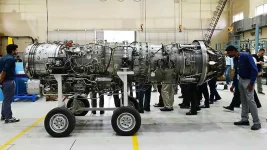
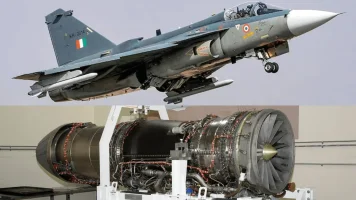
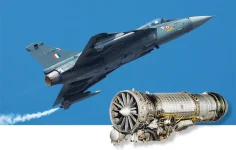
With the Indian Air Force facing significant delays in receiving its Light Combat Aircraft (LCA) Tejas Mk1A fleet due to the slow delivery of General Electric (GE) F404-IN20 engines from the United States, public debate has naturally shifted toward finding alternative powerplants.
However, according to an experienced former engineer from Hindustan Aeronautics Limited (HAL), swapping the current GE engine for another option is far from a quick fix.
Speaking anonymously, the aerospace expert revealed that integrating a different engine would demand extensive airframe redesigns, essentially resulting in the creation of a completely new variant of the fighter jet.
In modern aerospace engineering, an aircraft's engine is much more than just a source of forward thrust; it acts as the core of the entire platform, dictating its overall shape, capabilities, and safety.
For an advanced fly-by-wire fighter like the Tejas Mk1A, the chosen powerplant directly influences the aircraft's weight distribution, structural stress points, air intake requirements, heat management, and the complex software that keeps the jet flying smoothly.
The former HAL official clarified that the Tejas Mk1A’s physical structure was custom-tailored specifically around the GE F404-IN20 engine. Choosing a different engine would mean overhauling several vital aerodynamic and internal systems.
For instance, the jet's air intakes are shaped to capture the exact volume and pressure of air that the GE engine requires.
An alternative engine, which would naturally pull in air at different rates, would force engineers to completely redraw and manufacture new intake channels to prevent critical issues like airflow disruption or engine stalling.
Beyond aerodynamics, the physical way the engine connects to the aircraft would need a drastic redesign. The internal structural mounts must be rebuilt to handle the specific vibrations, weight, and force generated by a new engine.
Furthermore, the electronic brain of the engine—the Full Authority Digital Engine Control (FADEC)—would require a complete software rewrite to guarantee it can communicate perfectly with the Tejas’s main mission computers and digital flight controls.
The rear section of the fighter would also face major structural changes. Because different jet engines have varying nozzle sizes, exhaust heat levels, and thrust outputs, the rear fuselage would need to be re-engineered with new heat shields and strengthened structural frames.
Even the aircraft's internal fuel delivery lines and cooling systems would have to be adjusted to manage the unique temperature and operational demands of a different engine.
Such a massive engineering overhaul would trigger a long and demanding certification journey.
The veteran engineer estimated that just the initial computer-based design and simulation phase—analyzing aerodynamics, structural strength, and heat distribution—could take up to 18 months.
This would be followed by another year and a half of rigorous ground tests to ensure the new engine does not cause dangerous vibrations or compatibility issues within the airframe.
Following these ground checks, the most time-intensive phase would begin: actual flight testing.
A re-engined Tejas would need to complete anywhere from 300 to 500 hours in the air under extreme conditions, evaluating everything from high-altitude performance to high-speed turns and weapons carriage.
In total, achieving Initial Operational Clearance (IOC) for this heavily modified jet would take an estimated five to seven years.
Testing would also stretch far beyond just making sure the engine works. Engineers would need to verify that a shift in the aircraft's centre of gravity does not make the jet structurally unstable during combat manoeuvres.
Crucially, because a new engine changes the way air flows over the wings and fuselage, every single weapon carried by the Tejas would have to be tested all over again.
Missiles like the Astra, precision bombs, and upcoming weapons such as the BrahMos-NG would need fresh safety certifications to ensure they can be released safely without colliding with the aircraft.
The former HAL professional stressed that public discussions often ignore these harsh engineering realities when suggesting quick replacements.
For example, while the French Safran M88 is a highly capable engine that successfully powers the Rafale fighter, placing it inside the Tejas would still require massive modifications to the aircraft's body due to its different dimensions and technical architecture.
Similarly, while India's homegrown Kaveri engine remains a critical piece of the nation's long-term goal for defence self-reliance, it is currently focused on a separate development path aimed at powering unmanned drones, such as the Ghatak UCAV, with certification milestones targeted around 2026.
The Kaveri has not yet reached the strict reliability metrics and operational standards required for a frontline manned fighter jet, making it an unviable immediate replacement.
Ultimately, navigating the current supply chain hurdles with GE, rather than redesigning the aircraft, remains the only practical path forward for the current Tejas Mk1A programme.