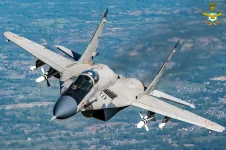
In a major leap for India’s aerial combat capabilities, the Indian Air Force (IAF) is equipping its fleet of over 55 MiG-29UPG fighter jets with the Advanced Short Range Air-to-Air Missile (ASRAAM).
Initiated in late March 2026, this vital upgrade officially phases out the ageing Soviet-era R-73 missiles.
By modernising the classic "Fulcrum" fighter with next-generation weaponry, the IAF is proactively adapting to new battlefield realities and ensuring this highly trusted aircraft remains a formidable asset for years to come.
Originally engineered by European missile manufacturer MBDA for intense close-quarters dogfights, the ASRAAM has proven exceptionally effective against a modern menace: inexpensive, low-flying drones.
Recent global conflicts have demonstrated how these unmanned systems can drastically alter the course of a battle, prompting militaries across the globe to overhaul their air defence tactics.
By pairing the ASRAAM with the MiG-29UPG, the IAF is confronting this evolving challenge head-on with a proven, highly agile solution.
A standout feature of this new European missile is its cutting-edge 128x128 resolution imaging infrared seeker, which excels at identifying targets that produce very little heat.
While the older R-73 system was built to chase the massive thermal exhaust of traditional fighter jets, it struggles against the minimal heat signatures of modern drones.
The ASRAAM easily overcomes this limitation, accurately tracking and intercepting these stealthy unmanned aerial vehicles with pinpoint precision.
The missile also boasts a crucial "Lock-On After Launch" (LOAL) capability, giving pilots an unprecedented level of combat flexibility.
Traveling at speeds exceeding Mach 3, the "fire-and-forget" weapon can be launched toward a suspected target zone even before the jet's radar has established a firm lock. Once in flight, the missile's autonomous sensors take over to hunt down small or highly maneuverable drones.
This drastically cuts down pilot reaction time and guarantees successful interceptions in fast-paced scenarios where standard targeting methods fall behind.
While deploying a sophisticated air-to-air missile against a cheap drone might seem like an expensive trade-off, military experts justify the cost by weighing it against the high-value targets these drones threaten.
Destroying a hostile unmanned aircraft before it can damage critical national infrastructure—such as radar stations, fuel reserves, or military bases—delivers undeniable tactical and financial benefits. In this context, the ASRAAM serves as an essential shield just as much as it is an attack weapon.
Equipping the 1980s-era MiG-29 with such an advanced weapon system essentially gives the legacy fighter a digital rebirth.
Over the years, the aircraft has seen numerous enhancements, but integrating a missile with an engagement range of over 25 kilometres—compared to the mere 10 to 15 kilometres offered by the R-73—provides it with a state-of-the-art combat "brain."
This upgrade guarantees the fighter can hold its ground in complex, multi-domain battlespaces filled with electronic warfare and unmanned swarms, keeping pace with capabilities fielded by regional rivals.
Operationally, this integration transforms the MiG-29UPG into a highly versatile guardian of the skies.
It can now seamlessly pivot between traditional fighter-to-fighter dogfights and modern air defence operations aimed at neutralizing drone swarms.
This dual-role capacity dramatically improves the IAF's overall fleet flexibility, proving that with the right technological updates, veteran aircraft can continue to deliver exceptional value in a rapidly changing world.