- Views: 3K
- Replies: 5
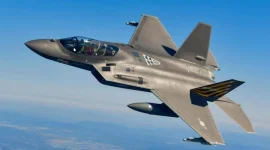
Should New Delhi’s ongoing pursuit of additional Dassault Rafale fighters hit a roadblock, the Swedish Saab Gripen E will likely re-enter the spotlight as a leading alternative for the Indian Air Force’s 114-jet Multi-Role Fighter Aircraft (MRFA) requirement.
The Gripen E has consistently been pitched as an affordable, high-performance combat jet that features modern electronics, low maintenance costs, and the promise of deep technology transfer.
Yet, while it proudly wears the Swedish flag, the aircraft is essentially a mosaic of international components, relying heavily on a global supply network anchored by the United States.
For India, a country whose current defence posture heavily prioritizes self-reliance, strategic independence, and insulation from foreign geopolitical leverage, relying so deeply on imported technologies presents a significant hurdle.
The American Engine Bottleneck
At the heart of this challenge is the aircraft's powerplant.While the French Rafale is driven by the domestically produced Safran M88 engine, the Gripen E relies on the F414-GE-39E, a 98 kN thrust turbofan manufactured by America’s GE Aerospace.
India is already familiar with the F414, having selected it for domestic production to power upcoming home-grown platforms like the Tejas Mk2 and the Twin Engine Deck-Based Fighter (TEDBF).
However, simply manufacturing the engine locally does not erase its origins; any Gripen E exported to India remains strictly governed by United States export control laws.
Consequently, purchasing the Gripen E would give Washington a de facto veto over the sale. Furthermore, any subsequent modernization efforts or engine tweaks would fundamentally depend on ongoing American goodwill and regulatory approval.
A Web of Global Regulations
The reliance on foreign suppliers goes far beyond the engine bay.The Gripen E is packed with American hardware, including a Honeywell Auxiliary Power Unit (APU), cockpit interfaces, transducers, and a variety of avionics.
A large portion of these systems are heavily regulated by the United States’ International Traffic in Arms Regulations (ITAR) and Export Administration Regulations (EAR).
Under these rules, India would need explicit permission from the U.S. to make modifications, transfer technology, or export the aircraft to a third party down the line.
The multinational nature of the jet is equally evident in its sensor suite.
While the highly capable Raven ES-05 Active Electronically Scanned Array (AESA) radar carries the name of Italian aerospace giant Leonardo, it is actually developed and built in Edinburgh, Scotland, and relies on collaborative international supply lines.
The jet's electronic warfare network is similarly stitched together using hardware from several different European vendors.
To fully grasp the Gripen E’s global footprint, one must look at its diverse supplier base. Open-source estimates indicate that U.S. components make up roughly 30-35% of the aircraft, while UK suppliers account for anywhere from 26% to 40% of its construction.
- United Kingdom: Provides the Raven AESA radar, Martin-Baker ejection seats, flight controls, hydraulics, and landing gear components.
- Germany: Delivers communication systems, radar parts, landing gear elements, and the Mauser BK-27 internal cannon.
- Italy: Supplies critical avionics and electro-optical targeting systems.
- Canada: Contributes various components linked to the engine and propulsion.
- Sweden: Saab retains control over the core mission computers, flight control software, data links, and the electronic warfare suite.
The Geopolitical Risk for India
For NATO-aligned nations, sharing the industrial workload across allied borders is often seen as a strategic advantage that fosters cooperation.But for New Delhi, this fragmented supply chain means that multiple foreign capitals hold the keys to the aircraft's lifecycle, future upgrades, and technology rights.
This vulnerability is magnified during times of international tension.
Should the Indian Air Force decide to arm the Gripen with a newly developed Indian missile, alter the core mission programming, or sell a locally built variant to an allied nation, New Delhi would likely have to chase down bureaucratic approvals from London, Washington, Rome, and Berlin—not just Stockholm.
Military history is filled with examples of complex defence purchases being derailed by sudden policy shifts, political sanctions, or halted export licenses.
An embargo from just one of the Gripen's many supplier nations could instantly ground the fleet by choking off spare parts or halting software updates.
The French Advantage
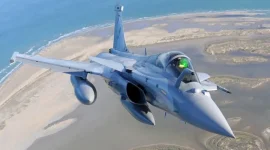
When placed next to the Rafale, the strategic contrast is stark.France has painstakingly ensured that the Rafale remains a highly sovereign platform.
Nearly all of its critical systems—from the M88 engines and RBE2 AESA radar to the highly regarded SPECTRA electronic warfare suite and mission computers—are designed and manufactured within French borders.
This domestic control allows Paris to authorize exports, technology transfers, and custom weapons integration without needing to ask a third country for permission.
For India, a nation that fiercely guards its strategic autonomy and operational independence, the streamlined, single-nation supply chain of the Rafale is a massive operational asset.
Domestic Ambitions and the Road Ahead
None of this diminishes the fact that the Gripen E is a formidable piece of engineering.It boasts a state-of-the-art AESA radar, cutting-edge sensor fusion, exceptional electronic warfare tools, and some of the lowest flight-hour costs of any modern fighter.
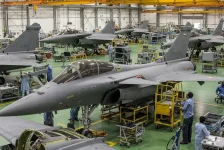
Furthermore, Saab has aggressively courted New Delhi by offering to set up local production lines and integrate Indian industries deeply into the aircraft's future.
However, local assembly lines do not automatically equate to sovereign ownership.
Even if the jets were rolled out of a factory in India, the foundational intellectual property of the most vital subsystems would remain offshore, strictly bound by the export policies of foreign governments.
This reality casts a long shadow over India’s broader aerospace roadmap. The Indian Air Force is currently shifting its focus toward a new generation of indigenous fighters, including the Tejas Mk2 and the Advanced Medium Combat Aircraft (AMCA).
These future fleets are designed around standardizing Indian-made weapons, sensors, and avionics. Inserting a foreign fighter that is tightly locked behind international intellectual property laws and ITAR restrictions could severely complicate India's push to create a unified, self-reliant defence ecosystem.
In the end, the most significant hurdle for the Gripen E in the MRFA competition is not its ability to fight, but the complex political web required to build it.
While its capabilities and economics are highly attractive, its deep reliance on American propulsion and a fractured Western supply chain means that its future would always remain subject to forces well outside of Sweden's—and India's—control.