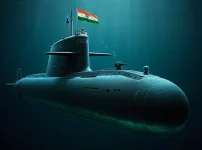
India is exploring a major shift in its maritime strategy by considering the development of nuclear-powered guided-missile submarines (SSGNs).
Naval planners and design experts are discussing the feasibility of modifying the existing S4-class nuclear-powered ballistic missile submarine (SSBN) platform to create this new variant.
This approach is seen as a practical, time-saving, and budget-friendly solution to address a crucial shortfall in underwater offensive capabilities while the country waits for its indigenous Project-77 attack submarines to materialize.
The highly anticipated Project-77, which aims to deliver a fleet of nuclear-powered attack submarines (SSNs) to the Indian Navy, recently received government clearance for its first two vessels in late 2024.
However, these new 10,000-tonne submarines are not expected to be combat-ready until the late 2030s.
This timeline creates a temporary weakness in India’s capacity to deploy rapid, aggressive submarines designed to protect aircraft carrier strike groups and track down enemy vessels.
Adapting the proven S4 blueprint into an SSGN would give the Navy a powerful, long-distance strike weapon much sooner than waiting for an entirely new submarine design to be finalised and built.
The current S4-class, represented by submarines like the recently commissioned 7,000-tonne INS Aridhaman, relies on a highly capable 83 MW pressurised water reactor.
Instead of arming the vessel with K-4 ballistic missiles intended for nuclear deterrence, the proposed SSGN model would be equipped with conventional, long-range submarine-launched cruise missiles (SLCMs).
The weapons payload could include the BrahMos-ER, which can hit targets roughly 800 kilometres away, the Nirbhay or ITCM systems boasting ranges between 1,500 and 2,000 kilometres, and even next-generation hypersonic cruise missiles in the future.
The technical appeal of this conversion lies in the flexible design of the submarine's vertical launch system.
The S4 submarines are built with silos that typically hold eight massive K-4 missiles. However, these large compartments can be modified to pack multiple, smaller cruise missiles into each tube.
Defence analysts estimate that a single silo could accommodate three to four Nirbhay or BrahMos-ER missiles.
This modification would allow one submarine to carry a devastating payload of 24 to 32 precision-guided weapons, effectively turning the vessel into a conventional "arsenal submarine" capable of striking both ships at sea and targets deep inland.
In a combat scenario, this newly configured SSGN would act as an underwater sniper.
Thanks to its nuclear propulsion, it can remain hidden beneath the surface for months, silently holding critical enemy assets at risk from hundreds of kilometres away.
Importantly, because its primary role is conventional warfare rather than strategic nuclear deterrence, the military can utilize this submarine to project power and neutralise threats without the severe geopolitical risks associated with deploying an SSBN.
Operating an SSGN is not an entirely new concept for the Indian military.
Back in 1988, India leased a Soviet Charlie-class nuclear submarine, which was commissioned as INS Chakra. That specific vessel was primarily designed to fire anti-ship cruise missiles.
This historical familiarity gives the Indian Navy a solid operational and tactical foundation to build upon, which is especially valuable today as naval activity and carrier deployments continue to surge across the Indo-Pacific region.
From a manufacturing and economic standpoint, repurposing the existing S4 framework makes excellent sense.
The current class of submarines already features around 75 to 80 percent indigenous components, a figure that is expected to rise with future builds.
By utilizing an established hull and reactor design, shipbuilders only need to alter the internal weapons bays and integrate the new missile systems.
This strategy drastically cuts down the immense research, development, and construction expenses associated with launching a brand-new SSN project from scratch.
Currently, the Warship Design Bureau is actively researching the viability of this initiative.
There are indications that the planned fifth and sixth hulls in the S4 production line might be built directly as SSGNs, bypassing the SSBN configuration entirely.
If this plan goes forward, India will be adopting a strategy successfully utilized by the United States Navy, which famously converted four of its nuclear-armed Ohio-class submarines into conventional guided-missile platforms to maximize their utility.
On a broader strategic level, an SSGN based on the S4 platform would act as a formidable sea-denial tool.
The capacity to unleash a massive barrage of precision cruise missiles from an undetectable, submerged location would create severe logistical and tactical nightmares for rival naval forces, especially adversary carrier groups sailing into the Indian Ocean.
Ultimately, it would grant India a robust, sea-based conventional strike capability that perfectly complements its existing air and land-based missile arsenals.