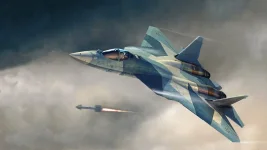
The Indian government has confirmed that it has not yet reached a final conclusion regarding the potential acquisition of Russia’s Su-57 fifth-generation stealth fighter.
Defence Secretary Rajesh Kumar Singh clarified the nation's stance during the Rising Bharat Summit, noting that while the platform is under observation, a definitive procurement path has not been established.
Strategic Deliberation Over Stealth Capabilities
Addressing inquiries regarding whether the Su-57 represents the most viable high-end option for the Indian Air Force (IAF), the Defence Secretary emphasised that the decision-making process is ongoing.He indicated that a variety of unresolved factors continue to prevent the government from making a formal commitment. This cautious approach reflects India's broader strategy of balancing immediate aerial requirements with long-term technological sovereignty.
The Su-57, Moscow’s premier stealth combat aircraft, has been a recurring subject in bilateral discussions. India previously participated in the joint Fifth Generation Fighter Aircraft (FGFA) programme based on this platform but withdrew in 2018. That exit was driven by concerns over:
- Stealth Performance: Doubts regarding the aircraft’s radar cross-section (RCS) and overall low-observability.
- Engine Technology: Issues with the developmental stages of the high-thrust engines required for "supercruise" capabilities.
- Cost and Workshare: Disagreements over the financial burden versus the level of high-end technology transfer.
Prioritising "Atmanirbharta" in Defence
A central pillar of India’s hesitation is the prioritisation of the indigenous Advanced Medium Combat Aircraft (AMCA). The Defence Secretary reaffirmed that the AMCA remains the focal point of India's fifth-generation ambitions.By focusing on a homegrown platform, the government intends to foster domestic aerospace expertise and eliminate reliance on foreign vendors for critical front-line technology.
Recent reports indicate that the AMCA project has entered a critical phase, with the first prototype rollout expected by late 2028 and a maiden flight targeted for 2029.
To accelerate this timeline, the Ministry of Defence has reportedly shortlisted private sector leaders—including Tata Advanced Systems, Larsen & Toubro, and Bharat Forge—to lead prototype development, moving away from a purely public-sector manufacturing model.
Multi-Track Procurement Challenges
The evaluation of the Su-57 is further complicated by India's existing Multi-Role Fighter Aircraft (MRFA) tender, which seeks 114 modern jets.While the French Rafale is often cited as a frontrunner for that requirement, the addition of a fifth-generation Russian platform would introduce significant logistical, maintenance, and geopolitical complexities.
Beyond technical specifications, any final decision will hinge on lifecycle sustainability, the depth of industrial technology transfer, and the ability to integrate indigenous weaponry.
For now, New Delhi appears content to monitor the Su-57’s operational performance—including its recent deployment in regional conflicts—while keeping its primary focus on the domestic AMCA leap.