- Views: 2K
- Replies: 2
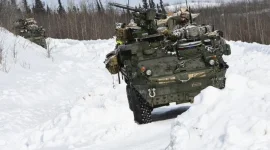
The Indian Army has halted discussions regarding the acquisition of American-made Stryker armoured vehicles. Defence sources confirm that the procurement initiative has been entirely shelved due to a lack of operational suitability.
Instead, military planners are executing a decisive pivot towards domestic alternatives to fulfil the requirements for their future wheeled infantry combat vehicle (ICV) fleets.
A crucial factor driving this cancellation is the mandatory need for water-fording operations.
The armed forces require their wheeled ICVs to independently navigate water bodies like canals and rivers, eliminating the need for complex combat engineering assistance. The standard US Stryker falls short of these amphibious benchmarks.
In stark contrast, the homegrown Wheeled Armoured Platform (WhAP)—co-developed by Tata Advanced Systems and the Defence Research and Development Organisation (DRDO)—features built-in amphibious capabilities.
Open-source data highlights that the WhAP utilises rear-mounted hydro-jets, allowing it to navigate aquatic obstacles at speeds up to 10 km/h, granting it unparalleled tactical adaptability across diverse Indian terrains.
Furthermore, high-altitude performance evaluations along the Eastern Ladakh frontier exposed glaring mobility issues with the foreign platform.
Operating in environments plagued by steep Himalayan inclines and thin air, the Stryker's 350-horsepower Caterpillar engine failed to demonstrate the necessary agility.
To thrive in these extreme altitudes, the Indian Army mandates robust power-to-weight ratios—a principle heavily emphasised in parallel projects like the newly developed Zorawar light tank.
The indigenous WhAP easily overcomes this hurdle, relying on a much more robust 600-horsepower Cummins ISX diesel engine, which significantly outperforms the Stryker in steep, high-altitude theatres.
This strategic redirection was previously foreshadowed by the Chief of Army Staff, General Upendra Dwivedi. While addressing future infantry mobility, the General downgraded the Stryker to merely an optional consideration, actively voicing the military's firm bias towards native engineering.
Consequently, domestically manufactured assets such as the WhAP and the Infantry Protected Mobility Vehicle (IPMV) are now at the forefront of procurement plans, having already proven their ability to satisfy the military's rigorous operational standards on the front lines.
Ultimately, dismissing the foreign platform perfectly mirrors the government's Atmanirbhar Bharat initiative, which aggressively targets self-reliance in the defence sector.
By shedding reliance on imported hardware, India is bolstering its own military-industrial complex.
The Tata-DRDO WhAP has proven to be a resounding success story in this regard, boasting a modular framework, a blast-resistant V-shaped hull, and the capacity to be configured into numerous variants—from command posts to heavily armed fighting vehicles.
Notably, the platform's world-class design has already led to successful inductions into Indian security forces and even achieved international export success to nations like Morocco.