- Views: 3K
- Replies: 10
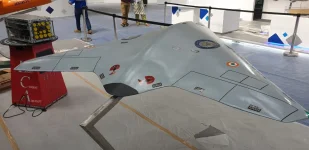
India’s indigenous stealth Unmanned Combat Aerial Vehicle (UCAV) program, known as Ghatak, has reached a critical juncture.
According to Dr. Samir V. Kamat, Chairman of the Defence Research and Development Organisation (DRDO), the project is currently awaiting final clearance from the Cabinet Committee on Security (CCS).
Once approved, the program is expected to see a surge in funding and the commencement of full-scale prototype development.
The current roadmap targets operational induction within the next seven to eight years.
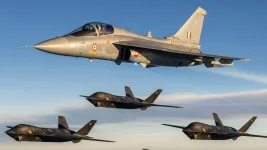
This timeline is designed to integrate the Ghatak seamlessly into the Indian Air Force's (IAF) future fleet, which will be anchored by the Advanced Medium Combat Aircraft (AMCA) and the Tejas Mk2.
Technical Milestone: The Dry Kaveri Engine
A primary focus for the technical team is the certification of the Dry Kaveri engine.hile earlier versions of the Kaveri engine struggled to meet the high-thrust requirements of manned fighter jets, the Ghatak UCAV offers a more forgiving performance profile.
This makes the UCAV an ideal platform to finally operationalize India’s indigenous turbofan technology.
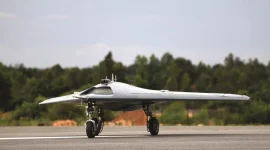
Recent progress with scaled Ground Test Vehicles (GTVs) has already allowed engineers to validate complex stealth shaping, autonomous control laws, and aerodynamic stability.
This internal testing ensures that the program can move rapidly once the CCS provides the official green light.
A 13-Tonne Deep-Strike Asset
The Ghatak is designed as a 13-tonne class stealth platform specifically engineered for high-risk, deep-penetration missions.Its primary roles will include:
- SEAD (Suppression of Enemy Air Defences): Neutralizing enemy radar and missile sites.
- Precision Strikes: Attacking high-value targets in heavily defended territory.
- ISR (Intelligence, Surveillance, and Reconnaissance): Gathering data in contested or "denied" airspace.
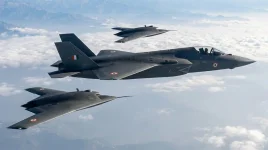
In this role, it acts as a "Loyal Wingman," flying alongside manned aircraft to absorb risks and expand the fleet's combat reach.
Strategic Impact and Force Multiplication
The IAF has reportedly expressed a preliminary commitment to 67 units in the first phase.These drones will not operate as standalone units but will be embedded within existing and future squadrons.
Initially, they are expected to pair with the 5th-generation AMCA and the Tejas MkII, eventually supporting the Su-30MKI and Tejas Mk1A fleets.
By acting as force multipliers, these UCAVs can carry additional munitions and extend the sensor range of the formation.
A significant strategic advantage lies in procurement flexibility: because UCAVs are not counted toward the IAF’s traditional "sanctioned squadron strength," the military can acquire them in large numbers to bolster combat mass without the constraints of pilot recruitment or extensive manned infrastructure.
Achieving Stealth at 4.5-Generation Prices
One of the most ambitious goals of the Ghatak program is its cost-efficiency.Current estimates suggest the unit price of a Ghatak drone will be comparable to that of a Tejas Mk1A fighter.
By delivering high-end stealth capabilities at the price point of a 4.5-generation manned fighter, India aims to field a "mass" of stealth assets—a feat that has proven difficult even for advanced Western nations due to the astronomical costs associated with platforms like the F-35.
Challenges on the Horizon
Despite the optimistic outlook, the path to a fully operational UCAV remains technically demanding.DRDO and its partners must still overcome significant hurdles, including:
- Engine Reliability: Ensuring the Dry Kaveri can sustain long-duration missions.
- Autonomous Systems: Developing AI capable of complex decision-making in combat.
- Secure Data-Links: Establishing unhackable communication between manned jets and their robotic wingmen.
- Stealth Materials: Validating the durability of radar-absorbent coatings under operational conditions.