- Views: 2K
- Replies: 2
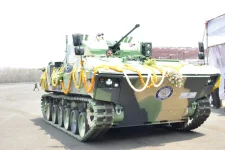
India has reached a historic milestone in its journey to modernise its military fleet.
The newly unveiled Vikram VT-21, a next-generation tracked combat vehicle developed to replace the Indian Army's ageing Soviet-era BMP-2 fleet, has achieved the highly demanding STANAG Level 5 protection standard.
This impressive feat was accomplished through the use of a fully homegrown composite hull, representing a major breakthrough in the creation of advanced, lightweight armour for the nation's defence forces.
This significant structural advancement was spearheaded by the Composites Research Center at the Combat Vehicles Research and Development Establishment (CVRDE), operating under the broader Defence Research and Development Organisation (DRDO).
As a key component of the Advanced Armoured Platform (AAP) programme, scientists faced the difficult task of engineering a vehicle body that could survive severe explosive shocks and direct enemy fire without adding excessive bulk.
The resulting hull ensures maximum survivability while keeping the total vehicle weight well under the critical 25-tonne mark.
To solve this weight-to-protection puzzle, researchers designed and rigorously tested multiple layers of specialised materials.
They utilised a combination of Glass Fibre Reinforced Plastic (GFRP) and Carbon Fibre Reinforced Plastic (CFRP), reinforced with internal cores made from PVC foam, Aluminium foam, and Aluminium Honeycomb.
The manufacturing relied on a highly controlled technique known as Vacuum Assisted Resin Transfer Moulding (VARTM).
This specific method guarantees that the protective panels are completely free of structural weaknesses or air voids, providing robust and reliable defence against battlefield threats.
Beyond the technical success, the project is also being widely praised for its extreme financial efficiency.
The DRDO facility managed to build the necessary VARTM manufacturing infrastructure entirely in-house for a mere ₹3.1 lakhs.
Furthermore, the entire suite of composite protective panels was manufactured for just ₹19.7 lakhs.
In the highly expensive sector of global military materials, this frugal engineering approach highlights India's ability to produce premium defence technology at a fraction of the traditional cost.
The real-world benefits of this innovation are profound.
Even when fully equipped with its advanced 30mm crewless turret and anti-tank guided missile (ATGM) launchers, the Vikram VT-21 remains remarkably agile.
This reduction in baseline weight directly translates to enhanced speed, easier transportability, and superior amphibious capabilities for crossing rivers and water obstacles using integrated hydro-jets.
By trimming unnecessary mass through composite materials, the vehicle can navigate difficult terrains more effectively, offering soldiers a decisive tactical advantage.
Meeting the strict NATO-standard STANAG Level 5 requirements proves that these locally produced materials can withstand high-calibre impacts, artillery shrapnel, and severe blast waves in active combat scenarios.
This validation by the CVRDE is a strong indicator of India’s rapidly maturing capabilities in defence manufacturing.
It proves that the domestic industry can independently design and secure cutting-edge armoured platforms without relying heavily on foreign technology or imported metal armour plating.
Developed through a collaborative public-private partnership involving the DRDO, Tata Advanced Systems, and Bharat Forge, the Vikram VT-21 currently boasts around 65% indigenous content, with active plans to reach 90%.
This successful implementation of composite armour perfectly aligns with the national 'Atmanirbhar Bharat' initiative.
The lessons learned and the affordable technologies perfected during this programme are expected to become the foundation for all future Indian wheeled and tracked combat vehicles, ensuring that the armed forces receive world-class protection, exceptional mobility, and sustainable defence solutions.