The Indian Army is significantly enhancing the survivability of its K9 Vajra-T 155mm/52-calibre tracked self-propelled howitzers, originally manufactured by Larsen & Toubro (L&T) in partnership with South Korea's Hanwha Aerospace.
As these high-value artillery units frequently operate near the front lines, they face growing threats from low-cost suicide drones and loitering munitions like the Lancet and Harop.
To counter these evolving battlefield challenges, the military has introduced a state-of-the-art "survival kit" in 2026.
This comprehensive upgrade provides the K9 fleet with a multi-layered defence system featuring hard-kill, soft-kill, and passive protective measures.
Automated Hard-Kill Defences
A prominent physical change to the artillery platform is the removal of the traditional manually operated machine gun.In its place, the Army has installed a domestically manufactured Remote Weapon Station (RWS), granting the crew an automated and highly precise method to engage airborne targets from the safety of the cabin.
This new remote system is designed to fire 12.7mm, and potentially 30mm, programmable airburst ammunition.
By detonating at a precise distance from an incoming drone, the rounds release a dense cloud of shrapnel that neutralises the threat mid-air.
To ensure maximum accuracy, the RWS utilises built-in thermal and electro-optical sensors.
These allow the system to autonomously identify, track, and lock onto rapidly moving targets, drastically cutting down response times and forming a robust hard-kill defence layer.
Electronic Warfare and Soft-Kill Capabilities
Alongside the physical weaponry, the Vajra-T now incorporates a soft-kill electronic warfare suite.Adapted from the proven D4 (Drone Detect, Deter and Destroy) framework, this compact system aims to neutralise aerial threats long before they reach striking distance.
Equipped with directional jammers on the turret, the system emits targeted high-frequency signals.
This interference blocks GPS navigation and severs the communication between the drone and its operator, causing the hostile craft to either crash or hover aimlessly.
When the howitzer is stationary or hiding, the electronic warfare suite can project a 360-degree electronic shield.
This invisible bubble effectively masks the vehicle's location from enemy reconnaissance drones, offering a crucial layer of stealth in contested environments.
Passive Armour Upgrades
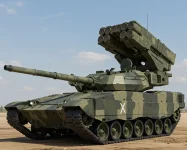
Taking cues from modern warfare tactics seen around the globe, the K9 Vajra-T is also adopting passive physical defences. Modular slat armour and "cope cages" are now being fitted over the top of the vehicle's turret.These steel mesh structures act as a physical barrier, intended to catch or prematurely trigger the warheads of incoming loitering munitions.
By forcing the explosion to occur away from the hull, the framework protects the crew and the howitzer's vital internal systems from direct armour penetration.
The design of this cage armour is highly practical, featuring foldable and removable sections.
This ensures the protective steel does not restrict the turret's ability to rotate a full 360 degrees, nor does it obstruct the elevation of the primary 155mm gun during fire missions.
Network-Centric Integration with Project Akashteer
Beyond physical and electronic armour, the K9 Vajra-T is stepping into the realm of network-centric warfare by linking up with Project Akashteer.Developed by Bharat Electronics Limited (BEL) at a cost of nearly ₹1,982 crore, Akashteer is the Indian Army’s indigenous, AI-driven air defence automation network.
By tying into this advanced intelligence web, the howitzer's crew receives instantaneous threat data gathered by external radars, ISRO satellites, and other battlefield sensors.
If a swarm of drones is spotted miles away, alerts and tracking feeds are beamed directly to the K9's internal screens, granting the crew vital early warning and unparalleled situational awareness.