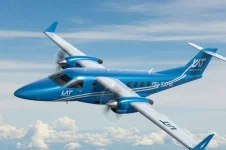
In a major leap forward for Indian aviation, LAT Aerospace—a venture established in January 2025 by Eternal and Zomato founder Deepinder Goyal alongside former Zomato COO Surobhi Das—has completed a successful test flight of its Lat One v0.2 prototype.
This milestone proves the viability of their ultra-short takeoff and landing (uSTOL) technology.
Operating from a new 50,000-square-foot research facility in Gurugram, the company is developing a hybrid-electric, 8-seater aircraft that combines the cruising speed of traditional airplanes with the nimble, space-saving capabilities of helicopters.
This recent achievement shows a massive improvement over the company's first experimental model, v0.1.
While the earlier version successfully proved it could lift off from a very short distance, it crashed moments later—a result the engineering team had fully predicted as part of their fast-paced, limit-testing design process.
With the new v0.2 model, the goal was to safely execute an entire flight mission from start to finish. The prototype met this objective perfectly, remaining in the air for over six minutes before returning for a secure and controlled touchdown.
The secret behind this capability is an innovative aerodynamic concept known as "blown wing technology."
By forcing fast-moving airflow directly over the aircraft's wings, the design generates massive amounts of lift even at low speeds.
This allows the aircraft to operate from compact "air-stops" requiring only 20 to 50 meters of space, rather than relying on massive traditional airport runways.
Ultimately, it offers a cheaper and mechanically simpler alternative to rotary-wing aircraft, while still flying as efficiently as a standard plane.
Out in the field, the v0.2 prototype delivered exceptional results that exceeded initial engineering estimates.
It flew faster than anticipated, comfortably cruising at 33 meters per second compared to the predicted 30 to 32 meters per second.
The aircraft was also pushed through aggressive, sharp turns, proving that its quick-detach wing mechanism was structurally robust enough to handle dynamic physical stress.
Furthermore, the test successfully verified the aircraft's automated closed-loop control system, which is vital for keeping such a unique aerodynamic design stable in the air.
Despite testing on a hot afternoon, the engineering team reported zero thermal management issues, marking a significant win for the aircraft's internal systems.
For the founders, who have backed the project with a reported $20 million in personal funding, the true victory lies in the data.
Goyal noted that the real-world flight logs matched their complex computer simulations, software-in-the-loop tests, and computational fluid dynamics (CFD) models almost perfectly.
This high level of accuracy in their digital testing drastically lowers the financial and safety risks as the startup moves toward building larger, passenger-ready prototypes.
Looking ahead, these uSTOL aircraft could revolutionize how we move people and cargo.
By flying out of small, unprepared clearings, they open up new possibilities for everyday urban air mobility, disaster response, and specialized military operations.
Highlighting its commitment to the latter, LAT Aerospace recently acquired the defence robotics startup Sharang Shakti to boost its autonomous systems, paving the way for advanced defence logistics and bringing high-speed connectivity to the world's most remote locations.