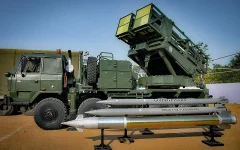
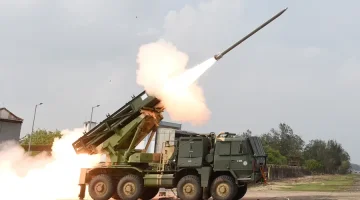
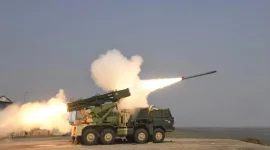
The Defence Research and Development Organisation (DRDO) has revealed that India's upcoming 120 km range Guided Pinaka Mk3, also known as the Long Range Guided Rocket (LRGR), will be significantly cheaper than the Israeli EXTRA rockets currently used in the recently inducted Suryastra system.
This cost efficiency makes the domestically produced Pinaka series a highly viable long-term solution for the Indian Army’s deep-strike artillery needs, giving a major push to the 'Aatmanirbhar Bharat' initiative in the defence sector.
Recent evaluations by the DRDO indicate that each Pinaka Mk3 LRGR unit will be priced under ₹1.5 crore. The system has already cleared initial testing and is progressing through user trials.
On the other hand, the 150 km range EXTRA rockets—which are manufactured by Israel's Elbit Systems and fired from the Indian Army's new Suryastra platform—were estimated to cost about ₹2.40 crore each back in 2018.
When factoring in current inflation and procurement expenses, the cost difference now exceeds ₹1 crore per rocket, heavily favouring the indigenous alternative.
To address urgent operational requirements, the Indian Army recently acquired two Suryastra systems via an emergency procurement contract worth approximately ₹293 crore, partnering with Pune-based NIBE Limited and Elbit Systems.
Based on the Israeli PULS (Precise & Universal Launching System), Suryastra acts as an interim solution capable of launching EXTRA rockets up to 150 km and Predator Hawk missiles up to 300 km.
However, defence officials view this as a temporary measure while India finalises the 120 km Pinaka Mk3 and the future 300 km Pinaka Mk4 systems.
Because the Pinaka Mk3 is far more affordable, the military can purchase and deploy these guided munitions in much larger quantities.
This financial advantage is crucial for sustaining heavy firepower during high-intensity warfare, allowing the Army to launch saturation strikes against critical enemy targets such as troop formations, supply chains, and command centres.
A better cost-to-effect ratio ensures that India can maintain its battlefield dominance without depleting its defence budget.
A major operational benefit of the LRGR-120 is its compatibility with the Indian Army's existing Pinaka launch vehicles, which are currently mounted on high-mobility Tatra trucks.
This backward compatibility means the new rockets can be integrated smoothly without requiring expensive modifications to the launchers, leading to reduced training time and quicker combat readiness.
The Pinaka Mk3 relies on advanced guidance systems, combining satellite and inertial navigation systems (INS) with aerodynamic control fins to strike targets with extreme precision while preserving the "shoot-and-scoot" capabilities necessary to avoid enemy counter-fire.
The military's strategy of procuring a limited number of Suryastra units for immediate border threats while simultaneously funding the Pinaka Mk3 and Mk4 programmes highlights a strong commitment to domestic defence manufacturing.
A proposed ₹2,500 crore investment for the 120 km Pinaka rockets will facilitate large-scale production through Indian defence firms like Munitions India Limited (MIL) and Solar Group. This move will drastically cut down reliance on foreign hardware and boost the local industrial ecosystem.
The LRGR-120 has already proven its pinpoint accuracy at its maximum range during early flight tests, and final user trials are moving forward rapidly.
Once formally inducted into the artillery regiments, the Pinaka Mk3 is expected to match or even surpass the performance of the imported systems in the 120 to 150 km range category.
By achieving this at a significantly lower lifecycle cost, the Ministry of Defence will be able to redirect saved funds toward developing even more advanced, ramjet-powered extended-range rockets in the future.