In a landmark shift for India’s domestic defence manufacturing, the private industrial consortium chosen to build the Advanced Medium Combat Aircraft (AMCA) will likely be authorised to employ its own dedicated test pilots.
Once the ₹15,000-crore fifth-generation stealth fighter enters its manufacturing phase, these corporate test pilots will take the controls for Customer Acceptance Flights (CAF) and pre-delivery evaluations.
This unprecedented move represents a massive transformation in how frontline military jets are flight-tested and delivered in the country, breaking away from historical reliance on state-run entities.
The core objective of this decision is to grant total end-to-end operational responsibility to the winning private sector team—currently a race between major groupings like Tata Advanced Systems, the Larsen & Toubro-Bharat Electronics Limited (BEL) combine, and the Bharat Forge-BEML consortium.
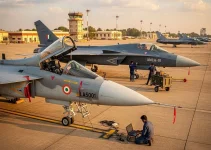
During the initial phase, however, the heavy lifting of developmental flight testing for the five planned prototypes will remain under the expert control of Indian Air Force (IAF) pilots from the Aircraft and Systems Testing Establishment (ASTE) and the National Flight Test Centre.
The real change takes effect when the project transitions from prototyping to mass production.
By fielding their own test pilots, the manufacturing consortium can ensure a seamless transition of the stealth fighters from the assembly line to the IAF.
These in-house aviators will be tasked with executing critical functional assessments, verifying aircraft performance, and flying the final acceptance missions before the military formally takes ownership.
While depending on civilian industry pilots for such duties is a well-established norm among leading global aerospace corporations, adopting this model marks a historic first for India’s most ambitious combat jet initiative.
This strategic shift is deeply rooted in the Ministry of Defence’s Atmanirbhar Bharat (self-reliant India) vision, which aims to elevate the private sector's role in advanced military projects.
By nurturing a cadre of highly skilled test pilots within the private aerospace industry, the AMCA programme will enjoy quicker testing cycles and alleviate the workload currently placed on active-duty military personnel.
More importantly, it cultivates highly specialised, home-grown expertise in operating complex fifth-generation technologies, such as advanced avionics, supercruise capabilities, and low-observable flight dynamics.
According to defence insiders, the winning private company will face stringent requirements to train and qualify its pilots.
This talent pool will be held to the strictest aviation safety benchmarks, working in tandem with the IAF and the Centre for Military Airworthiness and Certification (CEMILAC) to achieve full certification.
This highly regulated framework is designed to speed up the manufacturing and delivery phases, particularly following the completion of 1,800 mandatory developmental flights scheduled within a strict 84-month timeframe set by the Aeronautical Development Agency (ADA).
Ultimately, integrating private test pilots into the production pipeline boosts overall confidence in the execution of the AMCA programme, which aims for its first operational deliveries around 2035.
By entrusting the private sector with both the construction and the critical flight-testing phases of a sophisticated stealth fighter, India is demonstrating the rapid maturation of its aerospace ecosystem.
This collaborative blueprint paves the way for a self-sustaining industrial base that can independently produce and certify cutting-edge combat aircraft on a global scale.