- Views: 3K
- Replies: 7
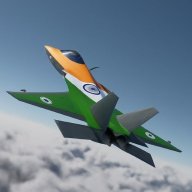
The Indian Air Force (IAF) is set to experience a massive upgrade in its aerial defence capabilities with the introduction of the Tejas Mk2.
According to senior figures at the Aeronautical Development Agency (ADA), this next-generation fighter will deliver roughly 120 minutes of combat patrol endurance while equipped with eight Beyond-Visual-Range (BVR) missiles.
To put this leap into perspective, the current Tejas Mk1 and Mk1A models max out at around 57 minutes of flight time carrying just four BVR missiles under identical combat conditions.
Furthermore, recent updates from the Defence Research and Development Organisation (DRDO) indicate the Mk2 is rapidly approaching its first flight, scheduled for the summer of 2026.
This dramatic boost in performance is the direct result of major structural and mechanical upgrades.
The Tejas Mk2 features an elongated body—measuring 14.6 metres, which is 1.35 metres longer than the Mk1A—and includes close-coupled canards to improve aerodynamic manoeuvrability.
It also boasts an expanded internal fuel capacity exceeding 3,400 kg. At its core, the aircraft is powered by the advanced GE F414-INS6 engine, producing 98 kN of thrust compared to the 84 kN of the older GE F404, resulting in far better fuel efficiency and raw power.
Additionally, open-source data reveals a significant stealth upgrade: the frontal Radar Cross Section (RCS) of the Mk2 has been reduced to just 25% of the Mk1A, making it much harder for enemy radars to detect.
In terms of firepower, the Tejas Mk2 is in a league of its own for single-engine fighters. The jet is equipped with 11 hardpoints capable of carrying up to 6.5 tonnes of external payload, almost double the 3.5-tonne capacity of the Mk1.
In an air-to-air role, it can comfortably carry eight BVR missiles, which can be expanded to ten using optimised dual-rack mounts.
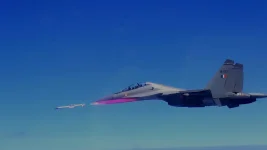
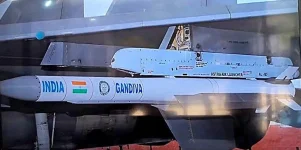
The jet is designed to seamlessly integrate India's indigenous Astra missile family, alongside proven Russian and French weapons.
To manage this lethal arsenal, the Mk2 integrates the homegrown Uttam Active Electronically Scanned Array (AESA) radar and a first-of-its-kind triple-layer auxiliary computer architecture, offering unprecedented combat redundancy.
For the IAF, doubling the combat endurance creates immediate tactical benefits.
When operating in highly contested zones like the Line of Actual Control (LAC) or vast maritime territories, the Tejas Mk2 can maintain a Combat Air Patrol (CAP) for over two hours fully armed.
This extended loiter time means fewer aircraft need to be cycled in and out of the combat zone, significantly reducing pilot exhaustion.
It also relieves larger, more expensive fighters like the Su-30MKI from flying everyday patrol missions and heavily cuts down the need for mid-air refuelling tankers.
Looking at the broader defence landscape, the Tejas Mk2 directly answers questions about the future role of traditional fighter jets in an age of drones and long-range rocket artillery.
The aircraft proves that heavily armed, manned platforms remain essential.
When ground troops require prolonged air support to secure borders against enemy incursions, a fighter that can stay in the sky longer and strike from a safe standoff distance is an invaluable asset.
The engineering philosophy behind the Mk2 focuses heavily on battlefield integration and flexibility.
Instead of competing with ground-based air defence systems or rocket forces, the Mk2 is built to work alongside them.
Its superior missile payload and loiter time allow the IAF to actively control the skies, offering vital top-cover for Indian Army deployments and supporting Indian Navy operations at sea.
This unified approach ensures India's combined military strength is far greater than the sum of its individual services.
As the project advances toward its anticipated maiden flight in mid-2026, the Tejas Mk2 highlights the rapid maturation of India's domestic aerospace industry.
Transitioning from a 57-minute endurance with four missiles to a 120-minute capability with eight is a fundamental transformation of India's air power, not just a minor numerical bump.
In modern warfare, where victory often depends on who can stay in the fight longest and launch the most missiles, the Tejas Mk2 promises to be a decisive force multiplier that will firmly secure India's aerial deterrence.