The military partnership between Armenia and India is growing rapidly, showing that Armenia is making a permanent shift away from relying on Russian weapons.
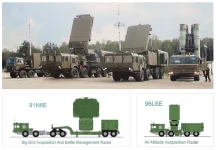
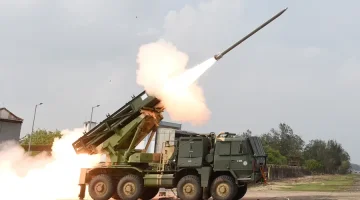
In February 2026, the Armenian Ministry of Defence showcased Indian-made Akash-1S air defence systems and Pinaka rocket launchers.
This display clearly showed that Indian military technology is now a core part of Armenia's long-term plan to modernize its armed forces.
The initial shipments of Indian weapons helped Armenia fix major weaknesses seen during the 2020 conflict, especially in areas like artillery, air protection, and battlefield monitoring.
Now, however, Armenia is moving beyond just fixing defensive problems. Its upcoming purchases seem designed to completely change the military power balance in the Caucasus region, specifically to counter Azerbaijan and its strong military ties with Turkey.
Building a Stronger Shield
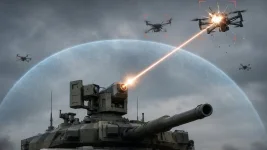
A major focus of this new phase is Armenia's desire to acquire the Akash-Next Generation (Akash-NG) air defence system.The current Akash-1S provides a solid defence up to about 30 kilometers. However, military planners in Armenia want a much larger protective shield.
This larger shield is needed to fight off long-range drones, distant missile strikes, and fast aircraft coming from Azerbaijan and Turkey.
The Akash-NG is a huge technological upgrade over the Akash-1S. It can hit targets much further away, reaching distances of 70 to 80 kilometers.
This allows it to protect a much larger area against enemy planes, drones, cruise missiles, and smart bombs.
Crucially, the Akash-NG uses a highly advanced Active Electronically Scanned Array (AESA) radar, which is a major improvement over the older radar systems used in previous versions.
This new radar technology is vital for Armenia's strategy. Azerbaijan relies heavily on Turkish drones, like the Bayraktar, which attack in groups and use electronic warfare.
The AESA radar is much better at resisting these electronic attacks. It can find targets faster, track multiple threats at the same time, and is much harder for the enemy to jam compared to older radars.
The Akash-NG missile itself is also heavily upgraded. It uses a new, lighter rocket motor that gives it more power right up until it hits the target.
This means the missile can quickly change direction to catch fast-moving targets trying to dodge it.
Together with the advanced radar, the Akash-NG would give Armenia one of the most advanced medium-range air defence systems in the region, second only to those used by NATO countries.
Developing Offensive Power
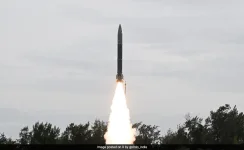
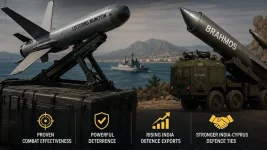
Armenia's military strategy is also changing to include strong offensive options to deter attacks.Because of this, India's Pralay missile is seen as a weapon that could completely alter the power dynamics in the Caucasus.
Advanced cost negotiations for this tactical surface-to-surface missile are reportedly underway between the two nations.
The Pralay is a tactical missile that can travel nearly 500 kilometers and hits its target at incredibly high speeds of Mach 5 to Mach 6.
Regular ballistic missiles follow a standard, predictable path, but the Pralay can change its course while in flight.
This makes it extremely hard for standard enemy air defence systems to shoot it down.
This creates a major problem for Azerbaijan.
The country has spent a lot of money on Israeli air defence systems, such as the Barak MX, which are built to stop planes, drones, and regular missiles.
However, intercepting a high-speed missile like the Pralay that can change direction at the last minute is a much more difficult task.
Buying the Pralay system would allow Armenia to launch accurate attacks on important military targets deep inside Azerbaijan.
Key locations like command centers, radar sites, airbases, supply routes, and weapons storage would all be within the missile's reach.
Having this weapon would shift Armenia's strategy from simply defending its borders to being able to strike back hard and cause severe damage to Azerbaijani forces.
Upgrading the Su-30 Fleet
Another major development is India's plan to upgrade Armenia's fleet of Su-30SM fighter jets.Armenia bought four of these Russian-made planes before the 2020 war, but they were barely used because they lacked modern weapons and systems.
As a result, the jets were costly to keep but offered little strategic value in combat.
India is in a strong position to turn these jets into powerful fighting machines.
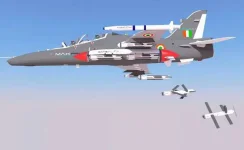
The proposed upgrades would add Indian-made electronics and the advanced Uttam AESA radar to the Armenian Su-30SMs.
These changes would give the pilots a much better view of the battlefield, improve their ability to fight off electronic jamming, and make tracking enemy aircraft much easier.
The biggest improvement, however, comes from adding new weapons.
Equipping the jets with the Astra air-to-air missile would give Armenia a modern weapon that can hit targets beyond visual range.
This would make it much easier to challenge Azerbaijani aircraft.
The Astra missile series is built for modern combat and would let the Su-30SMs shoot down enemy fighters from a safe distance.
Adding the Smart Anti-Airfield Weapon (SAAW) would turn the jets into precision bombers.
They could then safely target enemy runways, tough concrete structures, and military bases from far away.
Combined, these upgrades would transform Armenia's rarely used Su-30 jets into a powerful force that can both control the skies and conduct accurate bombing missions.
A Shifting Geopolitical Landscape
Looking past the weapons themselves, the political effects of these deals are very clear.The growing defence trade between India and Armenia has now reached an estimated $2 billion in total agreements.
Recent high-level discussions in early 2026 between top military officials of both nations have further solidified this bond.
This partnership shows a strong alignment between two nations dealing with similar political pressures in their regions.
Over the last ten years, Turkey, Pakistan, and Azerbaijan have built strong military and political ties, creating what some call a "Three Brother Alliance."
Turkey and Pakistan constantly support Azerbaijan with weapons and diplomacy, while also backing Pakistan on the Kashmir issue.
After the 2020 conflict, military help from Pakistan and drones from Turkey clearly boosted Azerbaijan's armed forces.
India's increasing military aid to Armenia is seen as a strategic move to balance this new alliance.
By making Armenia stronger militarily, India is putting pressure on the partnership between Turkey, Pakistan, and Azerbaijan.
At the same time, India is growing its own political influence in the Caucasus region and Eastern European security frameworks.