- Views: 1K
- Replies: 1
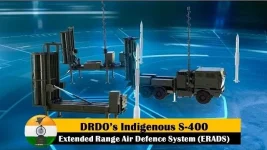
India is making significant strides in developing its own advanced air defence system, known as Project Kusha or the Extended Range Air Defence System (ERADS).
This indigenous programme is drawing close observation from military experts in Russia, especially after recent successful flight tests.
While Project Kusha is on track to become one of India’s most sophisticated domestically built surface-to-air missile networks, Russian commentators largely view it as a continuation of New Delhi’s push for self-reliance, rather than an immediate threat to Russian systems like the S-400 Triumf.
Currently, Russia remains the primary provider of strategic air defence platforms to India. According to Russian analysts, Project Kusha is being designed to work alongside existing systems, adding another layer of security rather than replacing the S-400 outright.
Experts suggest that India’s overarching goal is to construct a comprehensive, multi-tiered defence shield. This strategy aims to lessen the nation's reliance on foreign imports while still utilising advanced imported systems for their unique operational strengths.
In this framework, Project Kusha is expected to fill a crucial gap, operating between medium-range systems like the MR-SAM (with a range of about 80 km) and strategic long-range systems like the S-400.
Given India’s massive geographical size and the complex security threats it faces, Russian commentators emphasise that overlapping layers of air defence are essential.
Because of this, it is highly likely that domestically produced systems like Kusha will operate in tandem with imported platforms like the S-400 for years to come.
These systems will be integrated into the Indian Air Force’s broader network, known as the Integrated Air Command and Control System (IACCS), creating a robust and unified defensive grid.
A Modular and Cost-Effective Approach
One specific feature of Project Kusha that has intrigued Russian defence professionals is its modular design. The Defence Research and Development Organisation (DRDO) has chosen to use a single type of "kill vehicle" across different missile variants.By attaching different booster engines to this common core, the system can achieve varying ranges.
The Kusha system will feature three distinct interceptor missiles:
- M1: Capable of hitting targets at approximately 150 km.
- M2: Designed for targets up to 250 km away.
- M3: A long-range variant capable of intercepting threats at 350 to 400 km.
This cost efficiency is a major draw for the project. Open-source data indicates that acquiring five squadrons of Project Kusha is estimated to cost around ₹21,700 crore (roughly $2.6 billion). In comparison, India’s purchase of five S-400 squadrons cost approximately $5.43 billion (around ₹45,000 crore).
Furthermore, the individual interceptor missiles for Kusha are projected to cost nearly 50% less than their Russian equivalents, representing massive long-term savings.
The Challenge of System Integration
Despite the optimism, Russian experts warn that successfully testing a missile is only the first step in creating a fully functional air defence system. Several Russian publications have noted that the most complex challenge lies in integrating the various components into a cohesive ecosystem.A modern air defence network requires highly advanced Active Electronically Scanned Array (AESA) radars, secure high-speed communication links, and sophisticated battle management software capable of tracking and engaging multiple targets simultaneously.
Open-source reports suggest Project Kusha will utilise advanced S-band Long Range Battle Management Radars to provide surveillance coverage beyond 500 km. Furthermore, DRDO claims the system is designed to handle saturation strikes, boasting a single-shot kill probability of over 80%.
However, analysts familiar with Russia’s own struggles in developing strategic defence networks have expressed cautious scepticism regarding India’s aggressive timelines.
While they acknowledge the recent successful maiden flight test of the M1 interceptor in July 2026 as a major milestone, they stress that rigorous field testing, software validation, and complex system integration trials will be necessary before Project Kusha can be fully operational.
The system is currently slated for phased induction between 2028 and 2030.
A Strategy of Diversification and Autonomy
Russian commentary also reflects a deeper understanding of why India is investing so heavily in home-grown defence technologies.Analysts in Moscow increasingly interpret Project Kusha as a calculated move by New Delhi to safeguard against global supply chain disruptions, potential international sanctions, and the risks of relying too heavily on a single foreign partner.
Rather than viewing Project Kusha as India turning its back on Russian technology, many experts see it as a pragmatic step to build domestic industrial capacity.
This approach allows India to retain the flexibility to buy specialised, high-end capabilities from trusted international partners only when absolutely necessary.
From the Russian point of view, this strategy aligns perfectly with India’s long-standing policy of strategic autonomy.
Under this doctrine, domestically produced systems are designed to gradually take on larger roles in national security, without necessarily triggering the immediate retirement of critical imported platforms.