During its Republic Day military parade held at Republic Square in Yerevan on May 28, 2026, Armenia showcased a range of newly acquired military equipment, officially assigning traditional cultural names to several Indian-made defence systems.
This renaming highlights the growing strategic partnership between New Delhi and Yerevan, as the Armenian Armed Forces deeply integrate Indian technology into their national security architecture to counter regional threats.
Throughout the parade, specific Indian platforms were introduced using local terminology.
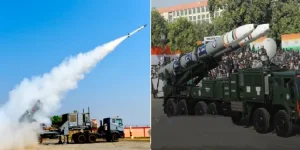
The Akash surface-to-air missile network—a medium-range system capable of intercepting fighter jets, drones, and cruise missiles—was introduced as "Lusan," translating to Lynx.
The Pinaka multi-barrel rocket launchers, which boast a strike range extending up to 75 kilometres in their upgraded variants, were rebranded as "Shant" (Lightning).
Furthermore, the Swathi weapon-locating radars, designed to rapidly track incoming enemy artillery, were named "Paylatsu" (Mercury).
India's 155mm artillery platforms were also given cultural identities: the Advanced Towed Artillery Gun System (ATAGS) and Trajan towed howitzers were named "Tir" and "Tork" after ancient pagan gods, while the highly mobile MArG self-propelled howitzer was called "Mihr," honouring a pre-Christian deity.
This renaming strategy illustrates Armenia’s intent to take full ownership of its imported arsenal, making the foreign-origin equipment a core part of its national military identity.
Following the official ceremonies, several of the newly named Pinaka (Shant) launchers were visibly stationed along Yerevan’s Tigran Mets Avenue.
The public display served as a clear demonstration of how seamlessly Indian artillery and rocket systems have been absorbed into active Armenian military formations.
The cultural assimilation of these weapons is part of a rapidly expanding bilateral defence partnership that accelerated in response to the South Caucasus security challenges, notably Armenia's conflicts with Azerbaijan in 2020 and 2023.
To counter these threats, Armenia has turned heavily to India, signing defence procurement contracts estimated at nearly $2 billion over the past six years.
These deals cover a wide spectrum of military hardware, from the recently displayed missile and artillery systems to advanced anti-drone technology and TATA Xenon tactical vehicles.
The active deployment of these systems underscores Yerevan’s strong trust in the reliability of India's defence manufacturing sector.
By choosing names derived from Armenian mythology and nature, the nation is sending a clear diplomatic signal of its long-term commitment to its alliance with India.
This process of localisation is designed to improve the morale of Armenian troops by creating a sense of familiarity with their new equipment.
Ultimately, this gesture reinforces the strategic ties between New Delhi and Yerevan, establishing a vital security framework in an increasingly volatile geopolitical landscape.