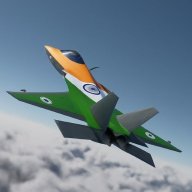
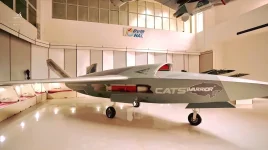
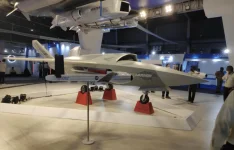
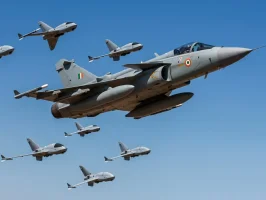
Hindustan Aeronautics Limited (HAL) is equipping the Combat Air Teaming System (CATS) Warrior drone with major artificial intelligence and autonomy upgrades.
Originally designed as a remotely piloted wingman, the system is now being fundamentally transformed into a semi-autonomous combat partner.
Drawing heavily from the realities of modern global conflicts, HAL’s upgraded Manned-Unmanned Teaming (MUM-T) architecture will allow the Warrior to think and act alongside lead fighter jets—such as the Tejas, Rafale, and the upcoming AMCA—with unprecedented independence.
Recent updates indicate that while the initial 2-tonne prototype has successfully undergone engine ground testing earlier this year, HAL is meticulously fine-tuning the complex flight-control software and cooperative teaming architecture, with the maiden flight now anticipated for 2027.
Independent Decision-Making in the Skies
The most critical capability being introduced is the Autonomous Tactical Decision-Making software.Instead of waiting for a human pilot to issue direct commands, the drone will be able to actively scan for threats, prioritise targets, and execute rapid defensive or offensive manoeuvres entirely on its own.
Historically, unmanned systems relied on a continuous stream of instructions from a mothership.
However, the modern battlefield is plagued by electronic warfare, signal jamming, and communication delays.
To overcome this, the new framework allows the Warrior to independently process its surroundings and react to danger, all while securely updating the human pilot on its status.
Navigating Without GPS
As seen in ongoing high-intensity conflicts, such as the war in Ukraine, standard GPS signals are highly vulnerable to enemy jamming and spoofing.To ensure the CATS Warrior remains fully operational in these denied airspaces, HAL has entirely reworked the drone's navigation protocols.
The system now features Visual SLAM (Simultaneous Localisation and Mapping) combined with advanced terrain-matching technology.
This upgrade allows the drone to visually scan the topography below it and navigate using physical landmarks, completely removing its reliance on vulnerable satellite positioning systems.
Simplifying Data for Pilots
The Warrior carries an array of advanced internal sensors, including an Active Electronically Scanned Array (AESA) radar and Infrared Search and Track (IRST) systems.However, transmitting all of this raw data back to a human pilot mid-flight is a recipe for information overload.
HAL engineers are currently solving the immense challenge of sensor fusion.
The drone’s internal computers must compress massive volumes of raw sensor data into clear, prioritised intelligence.
This refined data is then sent via a secure datalink to seamlessly integrate into the lead aircraft’s cockpit, heightening the pilot's situational awareness without causing distraction.
Upgrading Engine Power for Future Missions
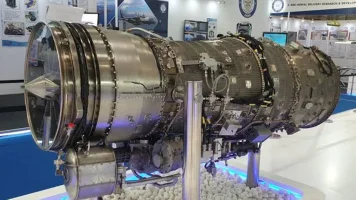
Current Warrior prototypes rely on the older PTAE-7 turbojet engine—a powerplant originally designed for the Lakshya target drone.While this engine has been effective for initial ground runs, it simply lacks the power required for high-intensity combat and advanced manoeuvres.
For the fully realised Warrior platform, HAL is waiting on the domestic 25 kN Hindustan Turbo Fan Engine (HTFE-25).
Although the indigenous engine's development has faced some administrative delays regarding testing infrastructure, its eventual integration will provide a massive boost in the thrust-to-weight ratio, allowing the drone to achieve higher speeds and potentially execute supersonic operations.
The Arrival of CATS Warrior II
Looking toward the future of the nation's aerospace defence, HAL has already begun developing a significantly larger and more capable variant known as CATS Warrior II.Scaling up from the current 2-tonne design, this next-generation model will weigh approximately 5 tonnes and is targeted for production between 2027 and 2030.
The larger frame will allow for an internal weapons bay—greatly reducing its radar signature for better stealth—and will provide the capacity to carry a much heavier payload, including multiple Astra Mk1 air-to-air missiles.
Through these combined advancements in AI, resilient navigation, and next-generation propulsion, the CATS Warrior is set to become a vital force multiplier for India's future air combat operations.