- Views: 2K
- Replies: 3
The Russian Sukhoi Su-34 "Fullback" is a highly capable tactical bomber designed for long-range, deep-penetration strikes.
However, despite a long history of purchasing Russian military hardware, the Indian Air Force (IAF) never seriously considered adding the Su-34 to its fleet. Instead, India chose to rely on and aggressively expand its trusted Su-30MKI inventory.
The rejection of the Su-34 had nothing to do with its performance or specifications. Rather, the bomber simply did not align with India's military strategy, current fleet composition, or future modernisation goals.
The primary roadblock for the Su-34 was the overwhelming success of the Su-30MKI itself. Introduced to the IAF in the early 2000s, the Su-30MKI was crafted from the ground up as an advanced multirole fighter.
While the Su-34 focuses heavily on ground strikes with only limited air-to-air skills, the Su-30MKI can seamlessly switch between air superiority, maritime strikes, escort duties, and precision ground attacks. This versatility is exactly what India requires for a potential two-front conflict.
In terms of firepower, the Su-30MKI left little room for a dedicated bomber. Both aircraft are capable of carrying heavy payloads of up to eight tonnes and have similar operational ranges.
More importantly, India successfully integrated the heavyweight BrahMos-A supersonic cruise missile onto the Su-30MKI.
HAL modified the fighters to carry this massive 2.5-tonne weapon, giving the Su-30MKI a strategic standoff strike range exceeding 300 to 400 kilometres.
This upgrade essentially provided the IAF with a strategic strike capability far beyond the Su-34's original design scope.
The Su-30MKI also holds a massive advantage in aerial combat.
The Su-34, with its heavy armour and distinctive side-by-side seating, was built for low-altitude bombing runs, making it substantially heavier and less manoeuvrable than standard Flanker variants.
For India, which must be prepared to face sophisticated aerial threats from neighbouring countries, having a highly agile, long-range fighter is far more critical than possessing a specialised ground-attack bomber.
Historical development timelines were another major factor. The Su-34's development was heavily stalled by the collapse of the Soviet Union, and it did not officially enter Russian service until 2014. India simply could not wait that long.
During those delayed decades, New Delhi poured immense resources into the Su-30MKI programme. HAL set up local production lines, and the aircraft was heavily customised with French, Israeli, and Indian avionics.
By the time the Su-34 was finally ready for operations, the IAF had already inducted over 260 Su-30MKIs. Introducing a completely new, heavy Russian bomber at that stage would have created a logistical nightmare for very little operational gain.
By the early 2010s, India was also actively trying to reduce its reliance on Russian equipment due to ongoing issues with spare parts and maintenance delays. Instead of buying more Russian platforms, India looked elsewhere to diversify its defence portfolio.
The IAF selected the French Rafale for its cutting-edge electronic warfare capabilities and focused heavily on homegrown projects like the Tejas and the upcoming Advanced Medium Combat Aircraft (AMCA). Buying the Su-34 would have contradicted this push for self-reliance and supply chain diversification.
Operational doctrine and geography further ruled out the Su-34. The aircraft was built for Russia's vast geography, featuring a large cabin designed for comfortable crew movement during incredibly long flights over Europe or the Arctic.
India's geographical requirements are vastly different. The IAF operates from forward bases positioned close to its borders in the west and the Himalayas in the north.
India's combat strategy relies on quick response times, network-centric operations, and fighters that can penetrate enemy airspace, drop precision weapons, and dogfight their way back—not prolonged, hours-long bomber missions.
Historically, India has never used dedicated tactical bombers as a separate class of aircraft. The IAF has always preferred adaptable fighters like the Jaguar, Mirage 2000, and Rafale, all of which can conduct strike missions alongside air defence operations.
The Su-34 would have severely disrupted this established approach by forcing a specialised, single-purpose aircraft into a versatile fleet.
Finally, keeping and upgrading the current fleet is far more cost-effective. Adding the Su-34 would have meant spending billions on new training pipelines, maintenance facilities, and weapons integration.
Instead, India is investing heavily in a massive "Super Sukhoi" upgrade for its existing fleet.
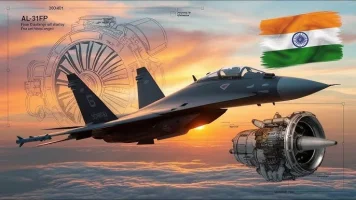
This sweeping modernisation programme will equip the Su-30MKI with advanced indigenous AESA radars (such as the Virupaksha), new electronic warfare suites, and anti-jamming multi-constellation GPS systems, effectively extending the fighters' service life by up to 20 years.
This approach delivers greater combat power while utilizing an already established logistics network.
While the Su-34 remains a formidable bomber for Russia, it simply answers a question the IAF had already solved.
The Su-30MKI provides the necessary strike power while continuing to dominate the skies, leaving no strategic, operational, or financial room for the Su-34 in India's long-term defence architecture.