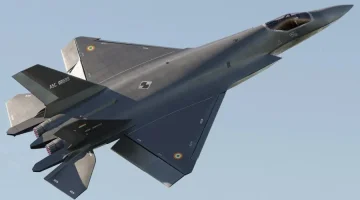
Turkish Aerospace Industries (TUSAŞ) has recently showcased its KAAN fifth-generation fighter jet making significant strides.
On July 31, 2026, the updated P1 prototype successfully concluded its powered taxi tests, officially beginning ground evaluations in preparation for its highly anticipated maiden flight.
With the P1 boasting aerodynamic and radar cross-section (RCS) refinements, TUSAŞ aims to have both this aircraft and a subsequent P2 prototype in the air by the end of the year.
For India, the Advanced Medium Combat Aircraft (AMCA) project is still navigating its early stages. However, examining Turkey’s swift and pragmatic approach to combat aircraft development provides valuable insights and strategic blueprints for India's own aerospace ambitions.
The Significance of Ground Trials
While taxi testing might appear to be a mundane phase of aircraft development, it is fundamentally vital.When the P1 prototype moved under its own power, it initiated the complex validation of how the jet's steering, braking, flight controls, and propulsion systems interact before facing the immense physical stresses of actual flight.
It serves as the ultimate diagnostic check on the tarmac before the aircraft is cleared for takeoff.
It is important to note that Turkey’s journey has faced real-world hurdles. Originally, the maiden flight for this phase was anticipated in the second quarter of 2026.
Supply chain bottlenecks forced a slight delay, illustrating that even highly prioritised, well-funded national defence projects are susceptible to timeline shifts.
The Strategy of Overlapping Prototypes
A standout characteristic of the KAAN initiative is TUSAŞ's aggressive use of parallel testing. Instead of relying on a solitary demonstrator jet to sequentially clear every hurdle, the manufacturer is operating multiple distinct prototypes at once.While the original P0 aircraft expands its speed and altitude limits in the air, the P1 undergoes ground integration, and a dedicated "iron bird" structural model undergoes physical stress tests.
This overlapping strategy drastically shortens the development lifecycle. TUSAŞ plans to fly a second prototype by mid-2026 and a third in 2027, eventually utilizing a fleet of six aircraft to accumulate thousands of testing hours.
Instead of waiting for one jet to finish its trials before building the next, modifications and data are continuously fed across an active fleet.
AMCA's Development Arc and Private Sector Integration
India’s AMCA is currently charting its course toward the runway. Following the Cabinet Committee on Security's approval in March 2024, the objective is to unveil the first prototype by 2027, with a maiden flight targeted around 2028 or 2029.The Aeronautical Development Agency (ADA) plans to build five prototypes rolled out in eight-to-nine-month intervals—a strategy that mirrors Turkey's multi-prototype approach, albeit on a later timeline.
Crucially, India is revolutionising its manufacturing approach. On May 27, 2026, the Ministry of Defence issued a Request for Proposal (RFP) for the ₹15,000 crore AMCA development phase to three private sector heavyweights: Tata Advanced Systems Limited, a Larsen & Toubro-BEL consortium, and a Bharat Forge-BEML group.
By shifting the lead integrator role away from the state-owned Hindustan Aeronautics Limited (HAL) for the first time in six decades, India is mirroring the agile, commercially accountable model that has allowed TUSAŞ to execute the KAAN programme so rapidly.
The Pragmatism of Interim Powerplants
Perhaps the most crucial shared philosophy between the two nations is the acceptance that waiting for a homegrown engine is a recipe for crippling delays.Turkey’s initial KAAN prototypes are powered by American General Electric F110 engines. In the background, Turkish firms TEI and TRMOTOR are aggressively developing the indigenous 35,000-lbf TF35000 turbofan engine.
While the TF35000 is slated for ground tests soon, it won't be fully integrated into the KAAN until roughly 2032.
India has wisely adopted the exact same playbook. The first AMCA prototypes will take to the skies utilizing proven GE F414 engines.
By decoupling the airframe's testing schedule from the highly complex, time-consuming process of domestic engine development, both countries ensure their stealth jets can mature avionics, stealth characteristics, and weapons systems on a reliable foreign powerplant today, while securing true self-reliance for tomorrow.