- Views: 4K
- Replies: 15
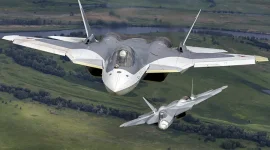
As of April 2026, Russia has significantly expanded its proposal to supply the Indian Air Force (IAF) with the Su-57 "Felon" stealth fighter.
Moving away from the basic export model, Moscow is now offering two highly advanced options: a heavily upgraded single-seat jet and a futuristic twin-seat variant designed to command drones.
This flexible, technology-focused offer aims to address the IAF's immediate operational needs while reviving the spirit of the older Fifth Generation Fighter Aircraft (FGFA) partnership.
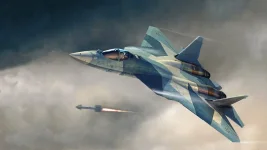
The core of this new pitch is the Su-57M1, a modernised single-seat fighter built for enhanced speed, stealth, and high-altitude combat.
A major highlight of the M1 is its cutting-edge AL-51F-1 (also known as Izdeliye 30) engine.
Open-source data indicates this new powerplant produces an impressive 16.5 tonnes of afterburner thrust and allows the jet to "supercruise"—meaning it can fly at supersonic speeds without using fuel-heavy afterburners.
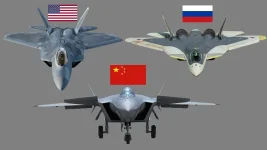
This engine provides a crucial advantage in range and acceleration, giving the IAF a powerful tool to counter advanced regional threats like China's rapidly expanding J-20 stealth fleet.
Alongside the engine upgrade, the Su-57M1 features physical refinements to make it harder for enemy radars to detect.
The aircraft boasts a wider body and a flatter profile, which not only improves its stealth characteristics but also creates more room in its internal weapon bays.
By carrying missiles inside rather than under the wings, the fighter maintains its radar-evading shape while still packing a heavy punch in heavily defended airspace.
Perhaps the most ground-breaking part of Russia's offer is the willingness to share the aircraft's core software.
By providing access to the jet's source code, Moscow would allow India's defence industry to seamlessly integrate homegrown technology.
This means the IAF could equip the Su-57M1 with India's upcoming Virupaksha AESA radar—a powerful indigenous system featuring roughly 2,400 Gallium Nitride (GaN) modules for superior targeting and electronic warfare resistance.
Furthermore, India could integrate domestic weapons like the Astra air-to-air missile and the new BrahMos-NG, transforming the aircraft into a deeply customised Indo-Russian platform.
Beyond the single-seat M1, Russia is also pitching a highly ambitious twin-seat model built for "Manned-Unmanned Teaming" (MUM-T).
This variant includes a second cockpit for a dedicated Weapon Systems Officer.
Instead of just managing the aircraft's own weapons, this officer would act as an airborne commander directing a swarm of drones in real-time.
This concept is widely viewed as a stepping stone to sixth-generation warfare, elevating the fighter from a simple strike aircraft into a flying command centre.
In this futuristic setup, the twin-seat Su-57 could control up to eight heavy combat drones, such as the stealthy Russian S-70 Okhotnik-B.
These unmanned wingmen can fly ahead into dangerous territory to spot targets, drop bombs, or draw enemy fire, vastly increasing the combat power of the manned jet while keeping the human crew safe.
Because the system architecture is designed to be "open," India could also seamlessly connect its own locally developed drone swarms and sensor networks to the ecosystem.
While the single-seat Su-57M1 is nearing operational readiness, the twin-seat drone commander version is still in the experimental phase, with a prototype reportedly being assembled at Russia's Komsomolsk-on-Amur plant.
By including this experimental jet in the package, Russia is clearly hoping to position the deal as a collaborative pathway into next-generation air combat, rather than a standard buyer-seller transaction.
On the manufacturing front, Russia is eager to set up a local production line.
Moscow has offered to help build up to 100 of these fighters at Hindustan Aeronautics Limited (HAL) in Nashik, utilising the existing infrastructure that currently supports India's Su-30MKI fleet.
However, the IAF is leaning towards a more cautious approach. Defence planners are reportedly favouring a direct, off-the-shelf purchase of roughly 36 to 40 fully built aircraft.
This smaller fleet would act as an immediate stopgap, ensuring India maintains air superiority against neighbouring fifth-generation fighters until its own indigenous Advanced Medium Combat Aircraft (AMCA)—expected to make its first flight around 2028—is finally ready for full-scale induction in the mid-2030s.