New Russian Su-57 Pitch to India Includes Advanced M1 Stealth and Twin-Seat MUM-T Drone Command Variants to Bridge AMCA Gap

New Russian Su-57 Pitch to India Includes Advanced M1 Stealth and Twin-Seat MUM-T Drone Command Variants to Bridge AMCA Gap


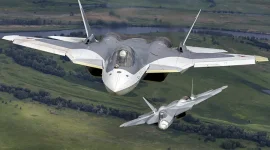
As of April 2026, Russia has significantly expanded its proposal to supply the Indian Air Force (IAF) with the Su-57 "Felon" stealth fighter.

Moving away from the basic export model, Moscow is now offering two highly advanced options: a heavily upgraded single-seat jet and a futuristic twin-seat variant designed to command drones.

This flexible, technology-focused offer aims to address the IAF's immediate operational needs while reviving the spirit of the older Fifth Generation Fighter Aircraft (FGFA) partnership.

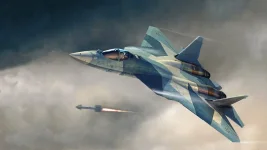
The core of this new pitch is the Su-57M1, a modernised single-seat fighter built for enhanced speed, stealth, and high-altitude combat.

A major highlight of the M1 is its cutting-edge AL-51F-1 (also known as Izdeliye 30) engine.

Open-source data indicates this new powerplant produces an impressive 16.5 tonnes of afterburner thrust and allows the jet to "supercruise"—meaning it can fly at supersonic speeds without using fuel-heavy afterburners.

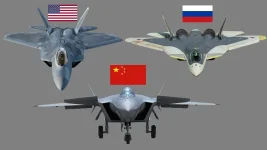
This engine provides a crucial advantage in range and acceleration, giving the IAF a powerful tool to counter advanced regional threats like China's rapidly expanding J-20 stealth fleet.

Alongside the engine upgrade, the Su-57M1 features physical refinements to make it harder for enemy radars to detect.

The aircraft boasts a wider body and a flatter profile, which not only improves its stealth characteristics but also creates more room in its internal weapon bays.

By carrying missiles inside rather than under the wings, the fighter maintains its radar-evading shape while still packing a heavy punch in heavily defended airspace.

Perhaps the most ground-breaking part of Russia's offer is the willingness to share the aircraft's core software.

By providing access to the jet's source code, Moscow would allow India's defence industry to seamlessly integrate homegrown technology.

This means the IAF could equip the Su-57M1 with India's upcoming Virupaksha AESA radar—a powerful indigenous system featuring roughly 2,400 Gallium Nitride (GaN) modules for superior targeting and electronic warfare resistance.

Furthermore, India could integrate domestic weapons like the Astra air-to-air missile and the new BrahMos-NG, transforming the aircraft into a deeply customised Indo-Russian platform.

Beyond the single-seat M1, Russia is also pitching a highly ambitious twin-seat model built for "Manned-Unmanned Teaming" (MUM-T).

This variant includes a second cockpit for a dedicated Weapon Systems Officer.

Instead of just managing the aircraft's own weapons, this officer would act as an airborne commander directing a swarm of drones in real-time.

This concept is widely viewed as a stepping stone to sixth-generation warfare, elevating the fighter from a simple strike aircraft into a flying command centre.

In this futuristic setup, the twin-seat Su-57 could control up to eight heavy combat drones, such as the stealthy Russian S-70 Okhotnik-B.

These unmanned wingmen can fly ahead into dangerous territory to spot targets, drop bombs, or draw enemy fire, vastly increasing the combat power of the manned jet while keeping the human crew safe.

Because the system architecture is designed to be "open," India could also seamlessly connect its own locally developed drone swarms and sensor networks to the ecosystem.

While the single-seat Su-57M1 is nearing operational readiness, the twin-seat drone commander version is still in the experimental phase, with a prototype reportedly being assembled at Russia's Komsomolsk-on-Amur plant.

By including this experimental jet in the package, Russia is clearly hoping to position the deal as a collaborative pathway into next-generation air combat, rather than a standard buyer-seller transaction.

On the manufacturing front, Russia is eager to set up a local production line.

Moscow has offered to help build up to 100 of these fighters at Hindustan Aeronautics Limited (HAL) in Nashik, utilising the existing infrastructure that currently supports India's Su-30MKI fleet.

However, the IAF is leaning towards a more cautious approach. Defence planners are reportedly favouring a direct, off-the-shelf purchase of roughly 36 to 40 fully built aircraft.

This smaller fleet would act as an immediate stopgap, ensuring India maintains air superiority against neighbouring fifth-generation fighters until its own indigenous Advanced Medium Combat Aircraft (AMCA)—expected to make its first flight around 2028—is finally ready for full-scale induction in the mid-2030s.
 
40 off the shelf + 100 local production Su-57X means end of AMCA. That's 8 stealth squadrons already, doubt IAF needs more than 12-13 stealth squadrons even if the sanctioned squadron strength is increased to 50-55.
 
Even if the above 100 -140 SU57 are purchased/manufactured in India, India should not ignore AMCA but should earnestly pursue AMCA 5.5/ 6 generation planes. If possible, the technology gained from the above SU 57s could be utilised in pursuing AMCA
 
40 off the shelf + 100 local production Su-57X means end of AMCA. That's 8 stealth squadrons already, doubt IAF needs more than 12-13 stealth squadrons even if the sanctioned squadron strength is increased to 50-55.
China is already having more than 15 squadrons of J20s and manufacturing many more. So India may need atleast 20 stealth squadrons for a two front war
 
China is already having more than 15 squadrons of J20s and manufacturing many more. So India may need atleast 20 stealth squadrons for a two front war
It's not about gaining numerical parity with China. They have far more 'problems' to deal with - like Japan, Philippines, South Korea, Vietnam, and then the US in Pacific. The massive chinese military buildup is not focused solely on India but distributed across various fronts.

India on the other hands just has only two fronts to handle, one of whose deterrence is just nukes as we saw last year.
 
Last edited:
MoD and IAF, both need to solve multiple puzzles within the limited budget. It's important that the they must treat the Tejas mk1a production as a national mission. We are currently stagnant; we need to move from "orders on paper" to "tail numbers on the tarmac."

Implement a strict 1:1 phase out of Jags with a one-year lead time. This ensures that as a Jaguar squadron prepares for retirement, a Tejas Mk1A squadron is already training and assuming operational duties, preventing any further gaps in our strike capability.

We must also greenlight 54-72 Su57M1 and 114 Rafales, this will provide us a cushion of those additional 8-10 squadrons for two front deterrence. For Rafales specially, plan the payments in a staggered, milestone based payment, so that those 3.25 lakh Crores can be expanded over 8/10 years, thereby avoiding massive hit to the capital budget, preserving funds for Army and Navy.

AMCA and Ghatak are core of our sovereignty and to ensure that orders of Su57 and Rafales are "last" heavy imports, they need to speeded up and protected. Sign the contract with GE for F414 for mk1, while massive numbers of Ghatak will ensure the first wave of SEAD causes maximum potency allowing Sukhois and Rafales to operate unchallenged.

Anyway, I dont think MTA will sign this year, so other alternate should be to secure the 30k crores for 12 Netra AWACS (6 mk1 and 6 mk2), which will allow our Rafales and Sukhoi's more situational awareness during war.

Lastly, as the squadrons for Su57 arrive, immediately send 1:1 squadron of Su30MKI for upgrades. This ensures that our current flagship jet stays relevant for next couple of decades and don't become an outdated junk.
 
You mention MTA. Selection 2027/2028? Contract terms agreed 2029? If Rafale goes through, will there be money in the budget to proceed?
 
I think contract will be speeded up for MTA next year

Anyway, out of the three candidates, C130J is already out as it cant carry Zorawar Tank or the latest DRDO AAP (both are in 23-25 MT Range). Plus they are eyeing it to perform dual role of Refeuler.
C390 is quite cost effective and that will be considered against A400M as we are already on the verge of paying a hefty amount for Rafales.

Regarding Rafales, If the amount is agreed upon delivery based over next 8/10 years, it will still be manageable. Anything less, we may have to compromise or postpone our one or the other projects, most probably Navy will suffer.
 
To me the C-390 is the runaway winner to meet IAF needs competitively. Also for long term production in addition to production for IAF. There is virtually no demand for A400M whereas C-390 has been winning a lot of customers. India could end up building far more C-390 for export than for IAF if a production plant were established in India.

Currently C-390 is selected over C-130J by most countries needing to replace old Hercules. IIRC 200-400 old airlifters will need replacement in the next 20 years.

The global medium airlift segment is entering a renewal cycle. Numerous operators of legacy C-130 variants are approaching the limits of cost-effective life extension. Structural fatigue, avionics obsolescence, and rising sustainment costs are pushing ministries of defence to reassess fleet strategies.

At the same time, the heavy transport category—represented by platforms such as the Airbus A400M Atlas—often exceeds the operational and financial requirements of small and mid-sized air forces. Procurement and lifecycle costs, infrastructure demands, and fleet size economics constrain broader adoption.

This creates a defined opportunity in the 20–30 tonne payload class.
 
Last edited:
Wow. It seems the posters here know far better than IAF, as to what the IAF should do.

I think, the CAS and all senior people should vacate their posts to be replaced by the posters here.

Then IAF does not have to worry. It will have 60 Sqns, more than required transports, helicopters, radars ( both AWACS and ground), missiles and other weapons.

It will be enoigh to take on USAF, USN, PLAAF and a few more air powers togethet.

All it requires is the brass to vacate their offices and let the posters here take over.
 
Wow. It seems the posters here know far better than IAF, as to what the IAF should do.
I tell you something IAF should not do: change requirements after they have been agreed and work has gone into meeting them. I have read of IAF doing that. Disruptive and delaying to development projects.

I have also read many accusations of IAF being biased towards procuring western aircraft.
 
Last edited:

Forum statistics

Threads
7,030
Messages
65,281
Members
5,285
Latest member
lusahunt
Back
Top