- Views: 2K
- Replies: 4
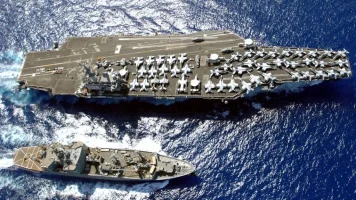
While debates persist about India's long-term maritime strategy, the Indian Navy is prioritising a pressing need: securing a second home-built aircraft carrier.
This step is vital to ease the burden on the ageing INS Vikramaditya and guarantee uninterrupted carrier presence across the Indian Ocean Region (IOR).
Even as financial and governmental approvals are being finalised, defence sources indicate a major shift in the Indigenous Aircraft Carrier-2 (IAC-2) programme. The project's design philosophy and strategic goals have fundamentally transformed.
The grand vision of building the massive INS Vishal-class supercarrier has been paused. Instead, naval planners are embracing a more feasible and sensible alternative, widely referred to within defence circles as an "Enhanced Vikrant".
For years, INS Vishal was the ultimate symbol of India’s naval ambitions. Early blueprints proposed a colossal 65,000-ton vessel featuring a CATOBAR (Catapult Assisted Take-Off But Arrested Recovery) system, designed to carry up to 60 aircraft. Planners even considered cutting-edge Electromagnetic Aircraft Launch Systems (EMALS) and nuclear propulsion.
A ship of that scale would have been a massive technological jump from both INS Vikramaditya and INS Vikrant, elevating India into an exclusive tier of navies operating heavy catapult carriers.
However, practical challenges have reshaped these ambitions. Staggering costs, intricate technological requirements, lengthy building schedules, and overlapping defence needs have prompted a strategic pivot.
Rather than committing to a high-risk supercarrier right now, the Indian Navy is leaning towards a dependable design. This decision heavily relies on the successful manufacturing and operational deployment of the country's first indigenous carrier, INS Vikrant.
Expected to cost approximately ₹40,000 crore, the upcoming carrier will likely share Vikrant's roughly 45,000-ton displacement. However, it will feature upgraded aviation facilities, superior mission systems, and better deck operations to accommodate future technologies.
Planners are expected to retain the STOBAR (Short Take-Off But Arrested Recovery) layout. By sticking with this proven launch and recovery method, the Navy sidesteps the immense costs and technical hurdles linked with developing EMALS and CATOBAR systems.
This realistic approach drastically reduces the time needed for construction. Officials from Cochin Shipyard Limited (CSL) have indicated that a repeat order could be delivered within eight years, fully utilising the domestic industrial base and skills forged during the first Vikrant project.
The logic behind this decision is deeply tied to immediate security requirements.
The Navy's core challenge is sustaining a functional two-carrier fleet at all times. While INS Vikramaditya is a vital asset, it is getting older and will demand more frequent maintenance.
Without a second indigenous carrier, keeping a constant watch over both the Bay of Bengal and the Arabian Sea would become nearly impossible.
Choosing an Enhanced Vikrant-class ship guarantees faster delivery, manageable costs, and minimal developmental gambles compared to a brand-new supercarrier design.
Surprisingly, the most revolutionary aspect of the IAC-2 project may not be its size, aircraft capacity, or launch mechanisms.
Current naval planning indicates that this new carrier's future will heavily feature unmanned aviation alongside standard fighter jets.
Defence experts are actively studying how the vessel can integrate shipborne Unmanned Combat Aerial Vehicles (UCAVs), loyal wingman platforms, long-endurance surveillance drones, and coordinated drone swarms.
This mirrors a global shift in naval warfare. Aircraft carriers are transitioning from traditional fighter bases into advanced, multi-domain hubs that manage a blend of crewed and autonomous systems.
For India, adopting these systems will massively boost the combat radius of its carrier strike groups.
Long-range surveillance drones can monitor the seas hundreds of miles away, while UCAVs can execute dangerous strikes without risking pilots. Loyal wingmen can protect crewed fighters, and drone swarms can be deployed for electronic warfare or distracting enemy radars.
Such advancements are critical today, especially given the rising strategic stakes in the Indian Ocean Region and the spread of advanced anti-access and area-denial (A2/AD) defence networks.
Future naval dominance will likely rely less on simply increasing the number of fighter jets and more on seamlessly integrating a variety of autonomous systems.
This positions IAC-2 to potentially be India’s very first aircraft carrier purposefully built to support heavy unmanned aviation operations.
This strategy perfectly complements the military's ongoing investments in domestic naval drones and autonomous combat technologies.
Ultimately, the current IAC-2 plan is vastly different from the original INS Vishal concept. Instead of waiting decades for a revolutionary supercarrier, the Navy is choosing an evolutionary, drone-ready platform that perfectly balances affordability with urgent operational needs.
However, the dream of a massive CATOBAR carrier is not entirely scrapped. It may still materialise in the distant future as India's domestic defence technologies mature and strategic demands evolve.